Key features of cubic graphs worksheets

A cubic can cross the x-axis up to three times, and its two ends head off in opposite directions. These free printable worksheets give the graph of a cubic on a numbered grid and ask for its x-intercepts, its y-intercept, its end behavior and where it is positive, with an answer sheet.

Part of the Functions and how many solutions pack — 5 sheets, one set to print.

Key features of cubic graphs
Key features of cubic graphs worksheet — Three zeros or a double zero, free printable with answer key

The answer key prints on a separate page.

What's on this sheet

The zeros come first, because everything else is organized around them. Between two neighboring zeros the curve stays on one side of the axis, so the question of where it is positive is answered one gap at a time.

Why this sheet works

Some cubics touch the axis at a zero and turn back without crossing it. That is a double zero. It is listed once, and the curve is on the same side of the axis on both sides of it, so it splits a positive interval in two without changing the sign.

How this one works

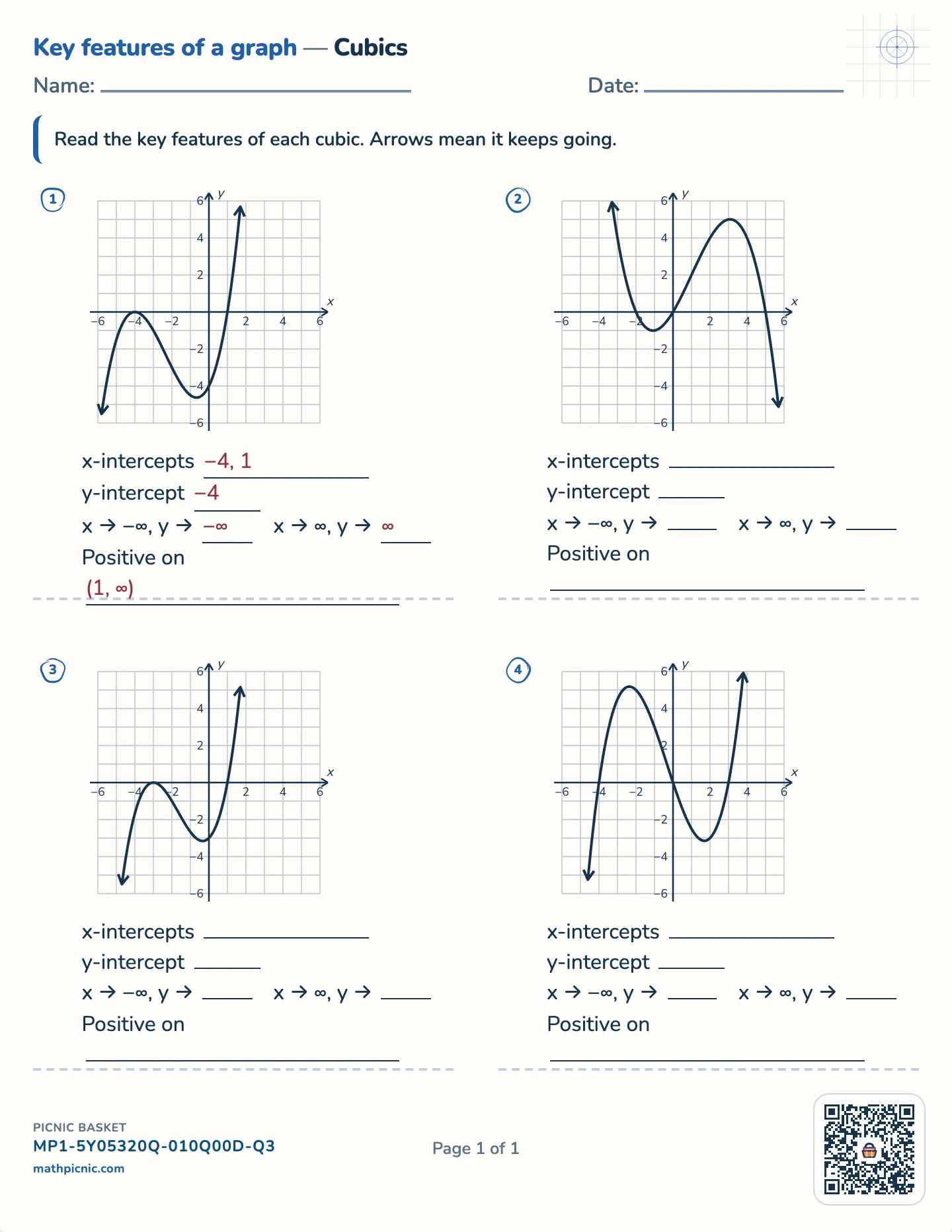
xy−6−6−4−4−2−2224466x-intercepts y-intercept x → −∞, y → x → ∞, y → Positive on

The cubic on the grid

x-intercepts−4, 1
x-intercepts−4, 1
y-intercept−4
x-intercepts−4, 1
y-intercept−4
x → −∞, y →−∞
x-intercepts−4, 1
y-intercept−4
x → −∞, y →−∞
x → ∞, y →∞
x-intercepts−4, 1
y-intercept−4
x → −∞, y →−∞
x → ∞, y →∞
Positive on(1, ∞)
  1. The x-intercepts are every place the curve meets the x-axis: x = −4 and x = 1. At x = −4 it only touches the axis and turns back, and that zero is listed once.
  2. The y-intercept is where the graph crosses the y-axis, where x = 0. Go up or down the y-axis to the curve: it crosses at y = −4.
  3. Follow the left arrow. As x goes further left, the curve heads down without stopping, so y → −∞.
  4. Follow the right arrow. As x goes further right, the curve heads up, so y → ∞.
  5. Positive means above the x-axis. Between the zeros, the curve is above it on (1, ∞).