SeriesAlternating
Name: Date:
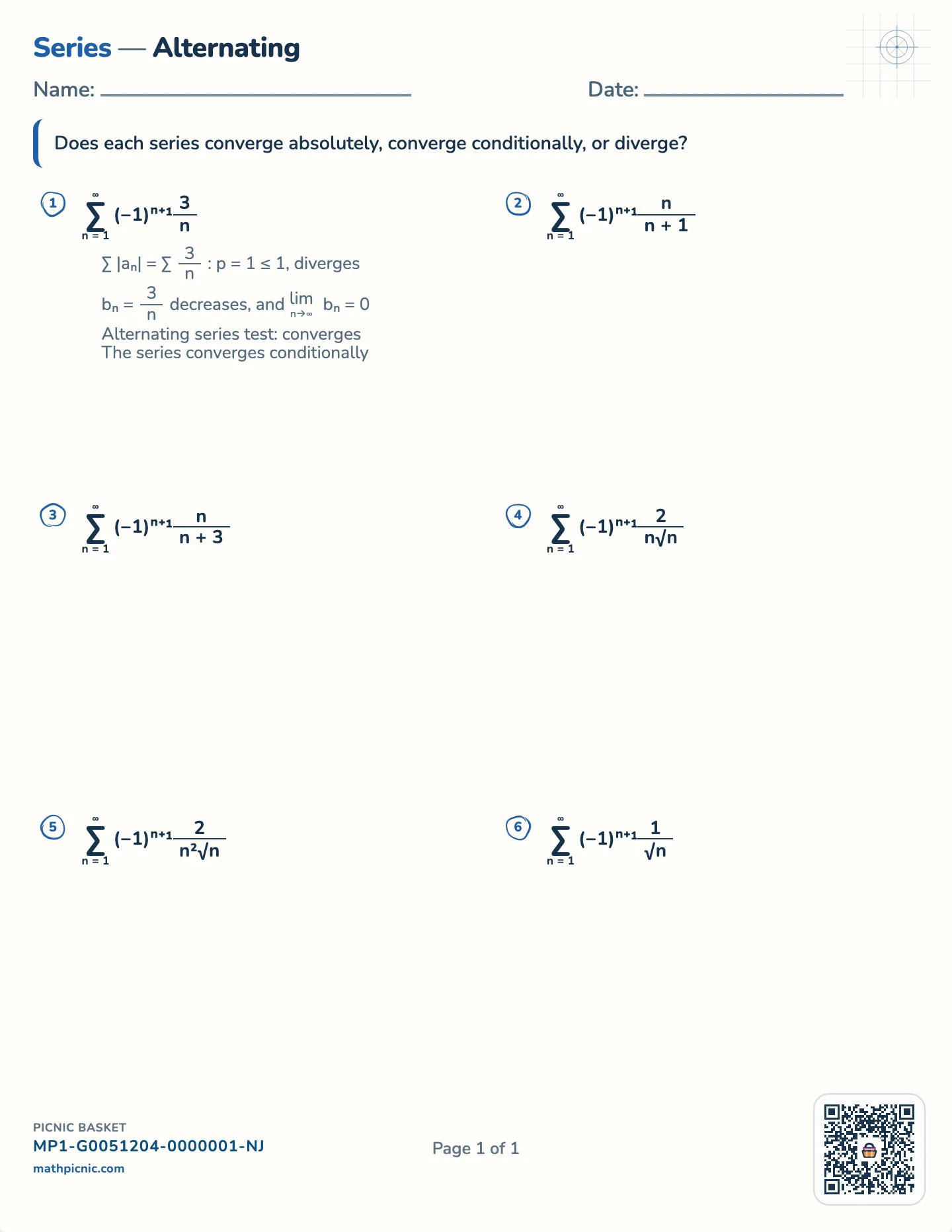
Does each series converge absolutely, converge conditionally, or diverge?
1(−1)ⁿ⁺¹3n
2(−1)ⁿ⁺¹nn + 1
3(−1)ⁿ⁺¹nn + 3
4(−1)ⁿ⁺¹2n√n
5(−1)ⁿ⁺¹2n²√n
6(−1)ⁿ⁺¹1√n

An alternating series has three possible answers, not two. It can converge absolutely, converge only because its signs alternate, or diverge. These free printable worksheets give about a third of each.
Part of the Series pack — 5 sheets, one set to print.
If they get stuck
The answer key prints on a separate page.
Start by dropping the signs. If the sizes form a series that converges, here a p-series with p > 1, the series converges absolutely and nothing else needs checking.
If the sizes diverge, the alternating series test is the second chance: when the sizes get smaller and go to 0, the alternating series still converges, and it converges conditionally. Σ (−1)ⁿ⁺¹/n is the classic example.
(−1)ⁿ⁺¹3/n