SeriesP-series and comparison
Name: Date:
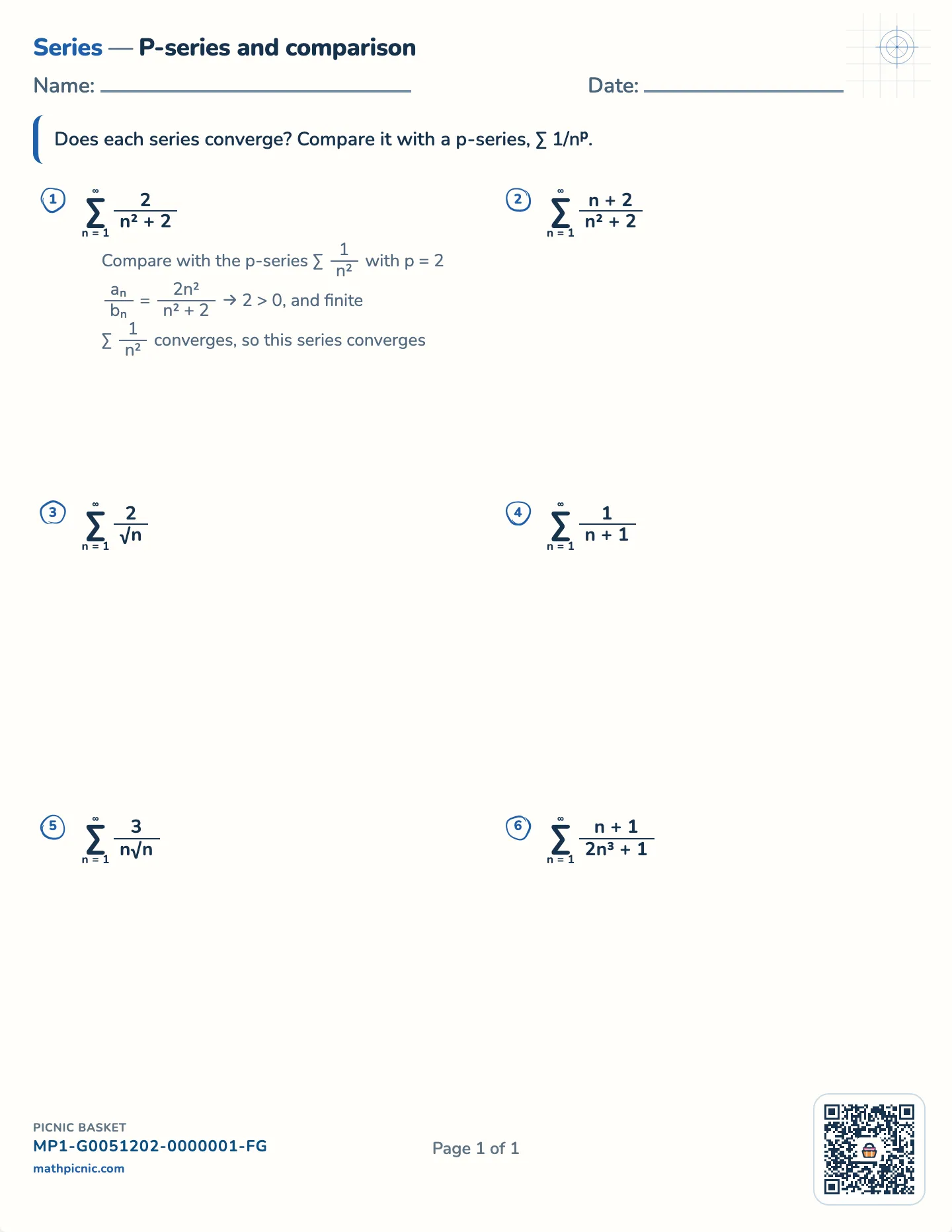
Does each series converge? Compare it with a p-series, Σ 1/nᵖ.
12n² + 2
2n + 2n² + 2
32√n
41n + 1
53n√n
6n + 12n³ + 1

A p-series, Σ 1/nᵖ, converges exactly when p > 1. These free printable worksheets practice reading off p, including roots like n√n, and then using a p-series to decide fractions like (n + 1)/(4n³ + 1) by the limit comparison test.
Part of the Series pack — 5 sheets, one set to print.
If they get stuck
The answer key prints on a separate page.
Half of every sheet is p-series: a number over a power of n, or over a root. √n is n to the 1/2, so 1/√n diverges, and n√n is n to the 3/2, so 1/(n√n) converges. The harmonic series, p = 1, is the one that diverges with terms that still go to 0.
The other half is a fraction of polynomials. For large n only the highest powers matter, so the term behaves like 1/n when the bottom is one power higher and 1/n² when it is two. The limit comparison test makes that exact: divide the two terms, find the limit, and if it is a positive number the two series do the same thing.