Area of figuresParallelograms
Name: Date:
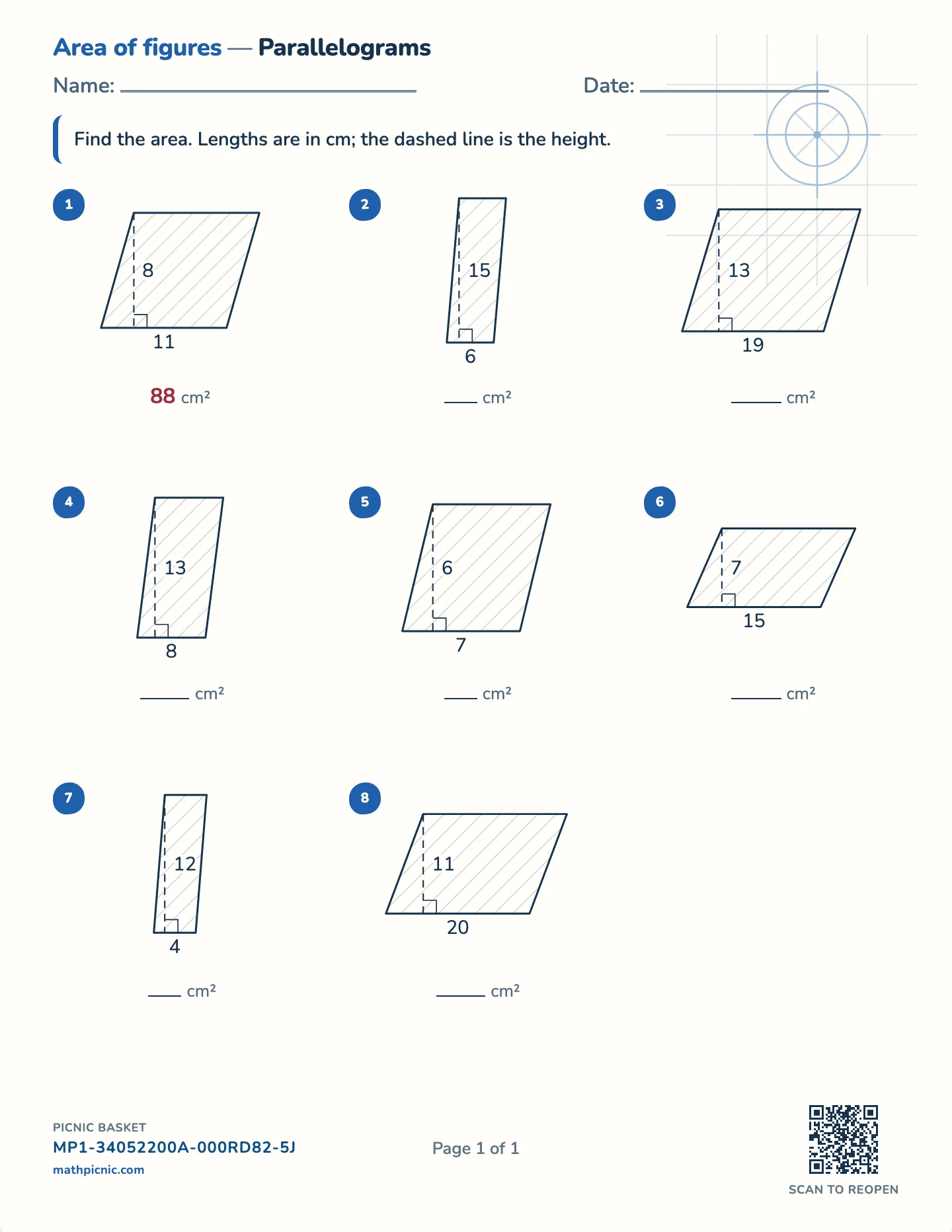
Find the area. Lengths are in cm; the dashed line is the height.
1 cm²
2 cm²
3 cm²
4 cm²
5 cm²
6 cm²
7 cm²
8 cm²

A parallelogram uses exactly the arithmetic its rectangle would: base times height. The catch is that the height is the perpendicular distance, not the sloping side. These free printable worksheets drill that one figure.
If they get stuck
The answer key prints on a separate page.
This is the parallelogram pulled out of the mixed area page on its own. Facing the same shape every time is what lets a child see why the formula works — slide the slanted triangle from one end to the other and the parallelogram becomes a rectangle of the same base and height, so base times height is all it ever needed.
The height is dashed with a right-angle mark and the slant side is left unlabeled, exactly so a child cannot use it by mistake. Measuring the slant edge is the single error this figure is built to prevent, because that number is always a little too big.
One question from a sheet like this one, worked a step at a time — with a sentence saying what just happened and why.
Area of a parallelogram, step by step