GeometryMissing edge
Name: Date:
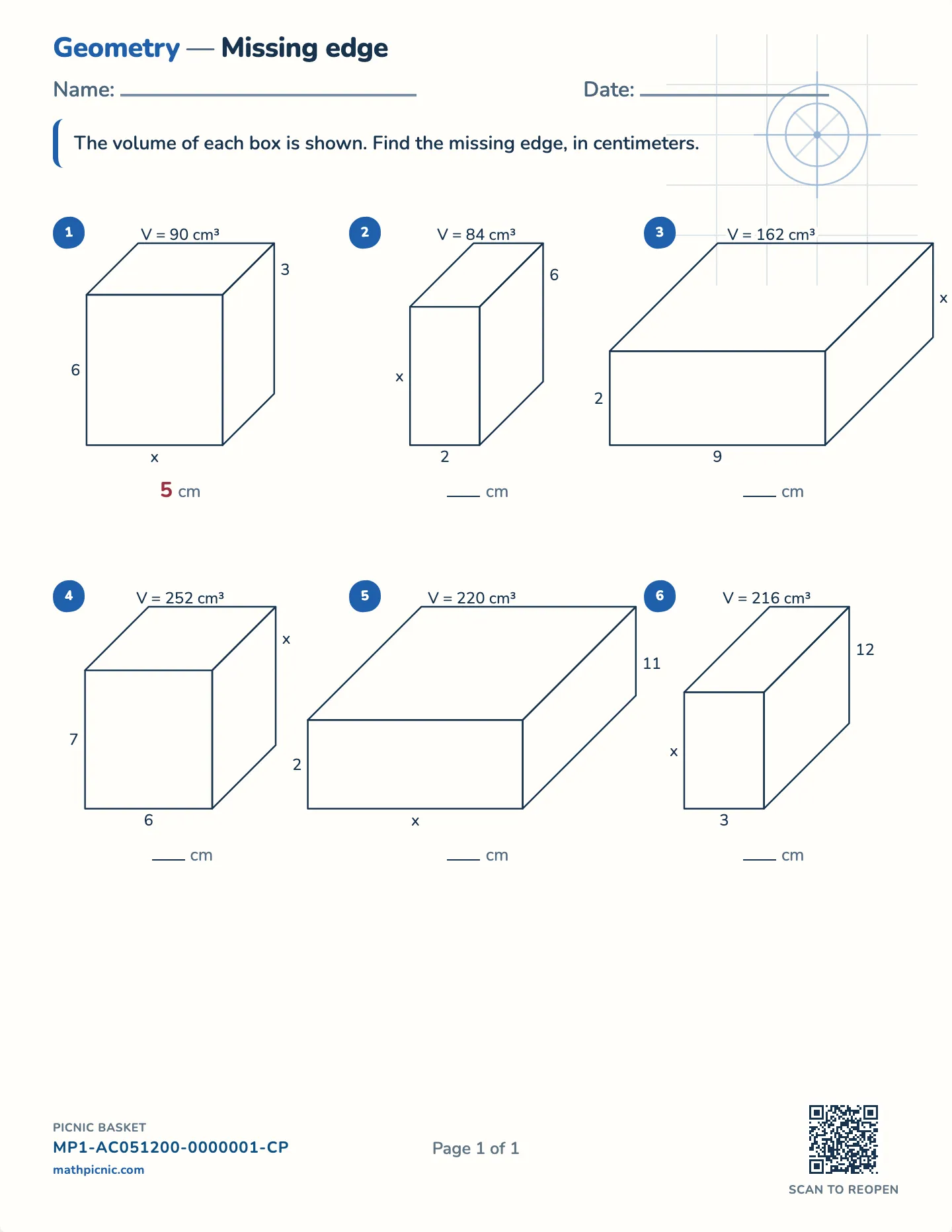
The volume of each box is shown. Find the missing edge, in centimeters.
1 cm
2 cm
3 cm
4 cm
5 cm
6 cm

If a box holds 120 cm³ and two of its edges are 4 and 5, the third has to be 6 — because 4 × 5 × 6 is 120. These free printable worksheets run the volume formula backward: the box shows its volume and two edges, and you find the one marked x.
If they get stuck
The answer key prints on a separate page.
It is the volume sheet's inverse, the way finding a missing side is the area sheet's. Volume is length × width × height, so if you know the volume and two edges, the third is the volume divided by the product of the other two. Multiplying the two you have first — into a single number to divide by — is the step that keeps it one division rather than two.
Every box is built from three whole edges, so the volume divides evenly and the missing edge is always a whole number — never 6.4. The figure is the same oblique box the volume sheets draw, in true proportion, so a child can see which edge is missing rather than hunt for it in a sentence.
One question from a sheet like this one, worked a step at a time — with a sentence saying what just happened and why.
Missing edge from the volume, step by step