PythagorasFinding a leg
Name: Date:
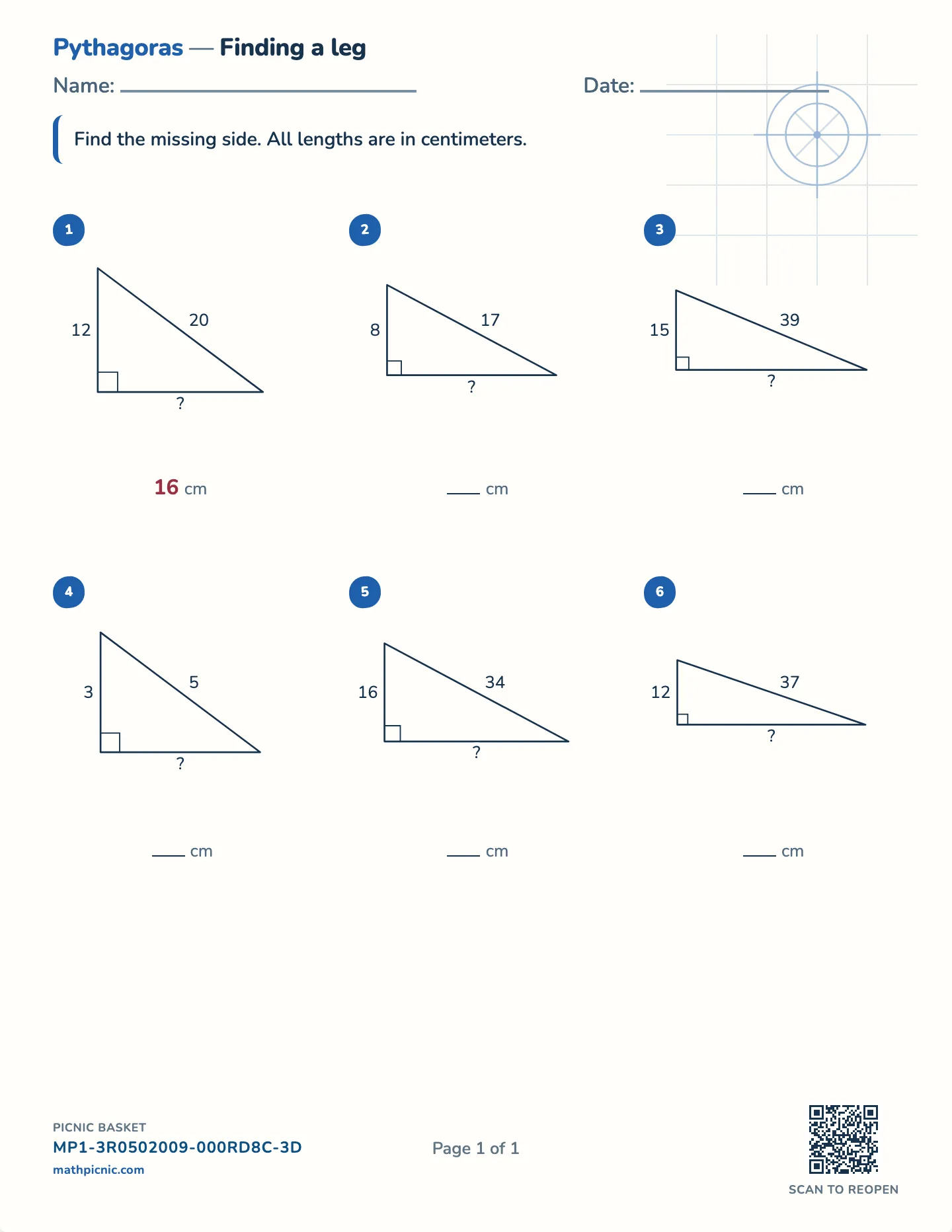
Find the missing side. All lengths are in centimeters.
1 cm
2 cm
3 cm
4 cm
5 cm
6 cm

Finding a leg runs the theorem backward: the hypotenuse squared minus the known leg squared, then a square root. These free printable worksheets drill that case alone, cut from the mixed page.
If they get stuck
The answer key prints on a separate page.
The mixed Pythagorean page mixes finding a leg with finding the hypotenuse, and telling them apart is where children slip: they add when they should subtract. This sheet asks only for a leg, so the subtraction step becomes the habit before the two are combined.
Every triangle is built from a Pythagorean triple — 3-4-5, 5-12-13, 8-15-17 and their multiples — so the missing leg is always a whole number and a child practices the method rather than a messy square root. The right angle is marked, and the hypotenuse is the side opposite it, which is the side to square first.
One question from a sheet like this one, worked a step at a time — with a sentence saying what just happened and why.
Pythagorean theorem: find a leg, step by step