PythagorasFinding the hypotenuse
Name: Date:
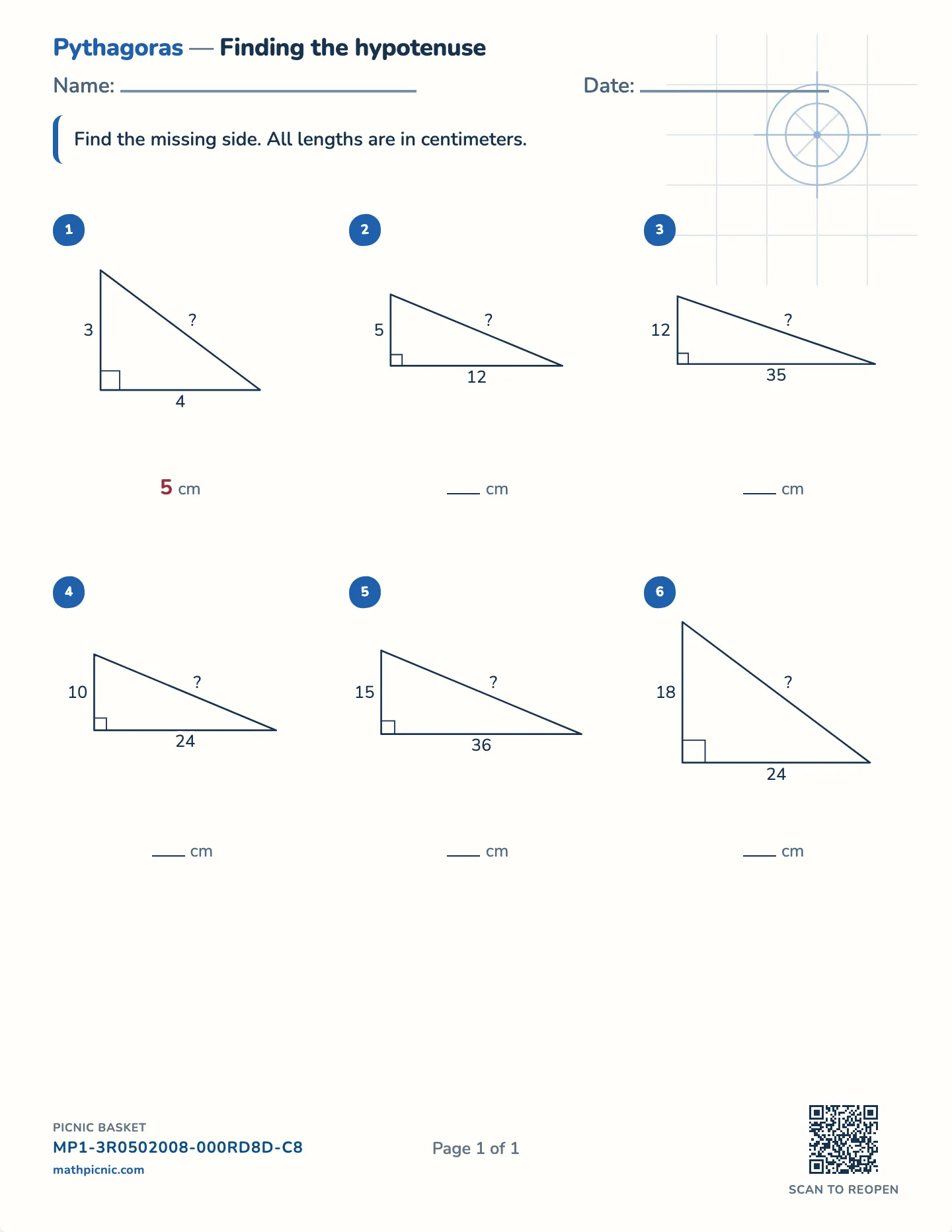
Find the missing side. All lengths are in centimeters.
1 cm
2 cm
3 cm
4 cm
5 cm
6 cm

The hypotenuse is the longest side of a right triangle: square the two legs, add them, then take the square root. These free printable worksheets drill that case alone, cut from the mixed page.
If they get stuck
The answer key prints on a separate page.
This is the forward direction of the theorem, split from the mixed page where it is interleaved with finding a leg. Facing only hypotenuse questions lets a child fix the add step cleanly before having to decide, on a mixed sheet, whether to add or subtract.
Every triangle is drawn from a Pythagorean triple and its multiples, so the two legs always give a whole-number hypotenuse — a thirteen-year-old practices the theorem, not the square root of 41 crammed into a blank the width of a number. The right angle is marked, and the missing side is always the one opposite it.
One question from a sheet like this one, worked a step at a time — with a sentence saying what just happened and why.
Pythagorean theorem: find the hypotenuse, step by step