GeometryTriangle inequality
Name: Date:
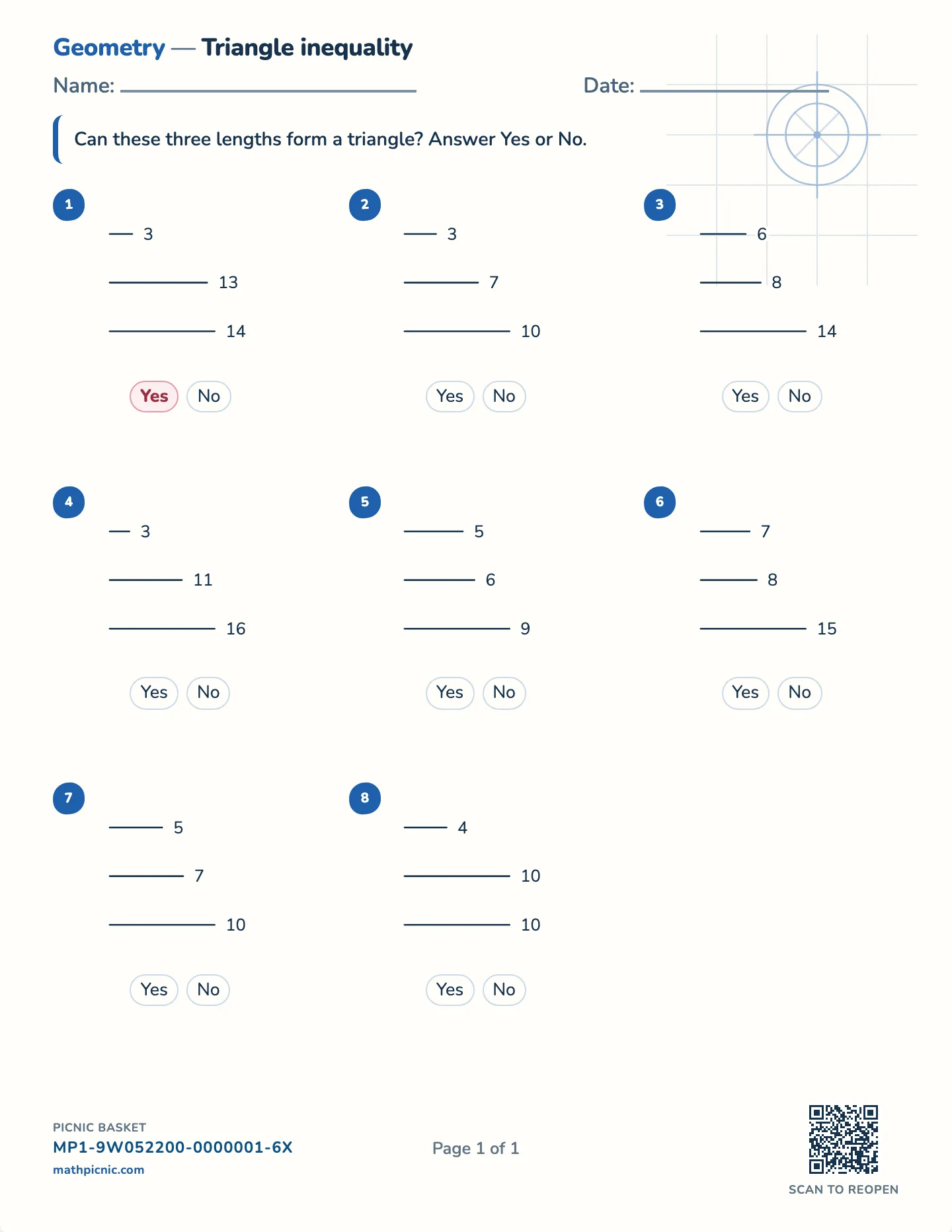
Can these three lengths form a triangle? Answer Yes or No.
1 YesNo
2 YesNo
3 YesNo
4 YesNo
5 YesNo
6 YesNo
7 YesNo
8 YesNo

Not every three lengths make a triangle. The two shorter sides have to add to more than the longest, or the short pair never reaches across. These free printable worksheets give three lengths and ask, simply, whether they can be the sides of a triangle.
If they get stuck
The answer key prints on a separate page.
The test is one addition and one comparison: add the two shorter lengths and check whether the total beats the longest. If it does, the sides close into a triangle; if it only ties, they lie flat in a line; if it falls short, they never meet. That is the whole triangle inequality, and it is worth stating as reaching rather than as a rule to memorize.
The lengths are drawn as three separate sticks, never assembled — laying the short two end to end over the long one would answer the question before a child has thought about it. The comparison stays arithmetic, which is where the standard wants it: given the numbers, could a triangle be built at all?
One question from a sheet like this one, worked a step at a time — with a sentence saying what just happened and why.
Triangle inequality, step by step