Complementary events worksheets

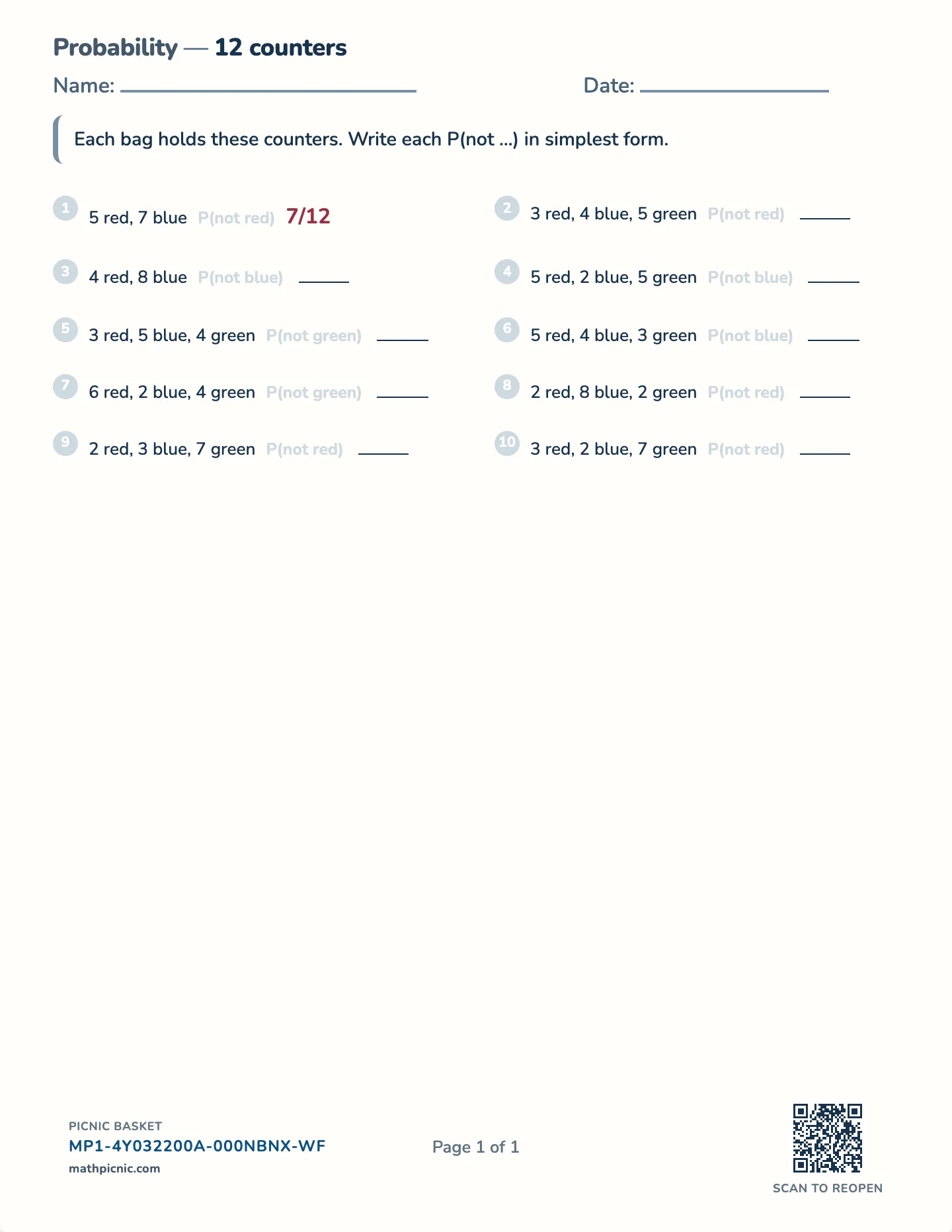
Every event has a complement — the chance it does NOT happen — and the two always add to one whole. These free printable worksheets practice finding P(not) from P(event), with an answer key.

Kid stuck on one? You don’t just get the sheet.

Complementary events
Complementary events worksheet — P(not) = 1 − P, free printable with answer key

The answer key prints on a separate page.

What's on this sheet

The rule is P(not) = 1 − P(event), and the reason it works is that something either happens or it does not, with no third option: the two probabilities cover every outcome, so together they make one. If the chance of drawing red is 1/4, the chance of not-red is 3/4, and the two summing to 4/4 is the check built into the idea.

Why this sheet works

There are two honest routes and comparing them is the lesson. A child can count everything that is not the event and write that over the total, or take the event's probability and subtract it from one — both give the same fraction. Working it both ways, and simplifying the result, is what turns the rule from something memorized into something seen.

How this one works

One question from this sheet, worked through a step at a time.

5 red, 7 blue — P(not red)

5 + 7=12
5 + 7=12
red:5
not red:12 − 5 =7
5 + 7=12
not red:7
+=
which is1
  1. Count EVERYTHING first, before the ones being asked about: 5 + 7 = 12 altogether. That is the bottom of the fraction, and it is the half that gets swapped for the wrong number.
  2. Read the question again: it asks for NOT red. So the wins are everything ELSE in the bag — all 12 of them except the 5 red, which is 12 − 5 = 7.
  3. Chance is the wins OVER the total — not over the rest. So it is 7 out of 12.
  4. Check it: the chance of red and the chance of not red have to fill the bag between them. 5 out of 12 and 7 out of 12 make 12 out of 12 — the whole bag, which is 1. If they do not add up, one of the two counts is wrong.