Estimating square rootsTo the nearest whole number
Name: Date:
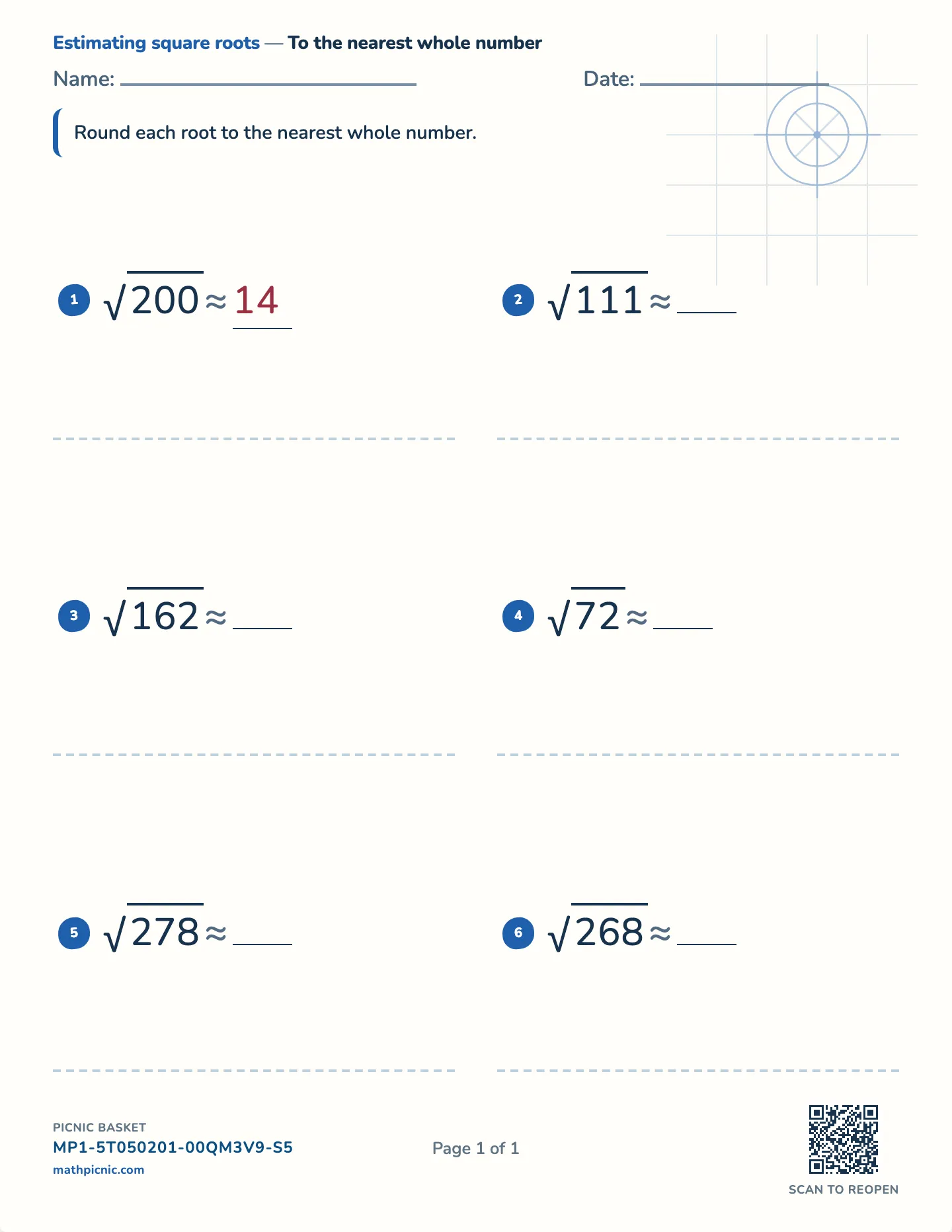
Round each root to the nearest whole number.
1200
2111
3162
472
5278
6268

√10 does not come out — so how big is it? These free printable worksheets teach the one method that works on any root: bracket it between the two perfect squares you already know.
If they get stuck
The answer key prints on a separate page.
√10 sits between √9 and √16, so it sits between 3 and 4. That is the whole method, it needs no calculator, and it works on a root a child has never seen. Knowing which perfect squares a number falls between is the only thing being asked, and every sheet here opens there.
Rounding to the nearest whole number is a real second step, not a harder version of the first. For √10 the bracket and the rounded value are both 3; for √15 they are 3 and 4. Deciding which end needs the midpoint — and the midpoint is a SQUARE: 3.5² is 12.25, so anything above that rounds up. Halving 3 and 4 and then guessing is the shortcut that gets the borderline cases wrong.
One question from a sheet like this one, worked a step at a time — with a sentence saying what just happened and why.
Estimating square roots, step by step