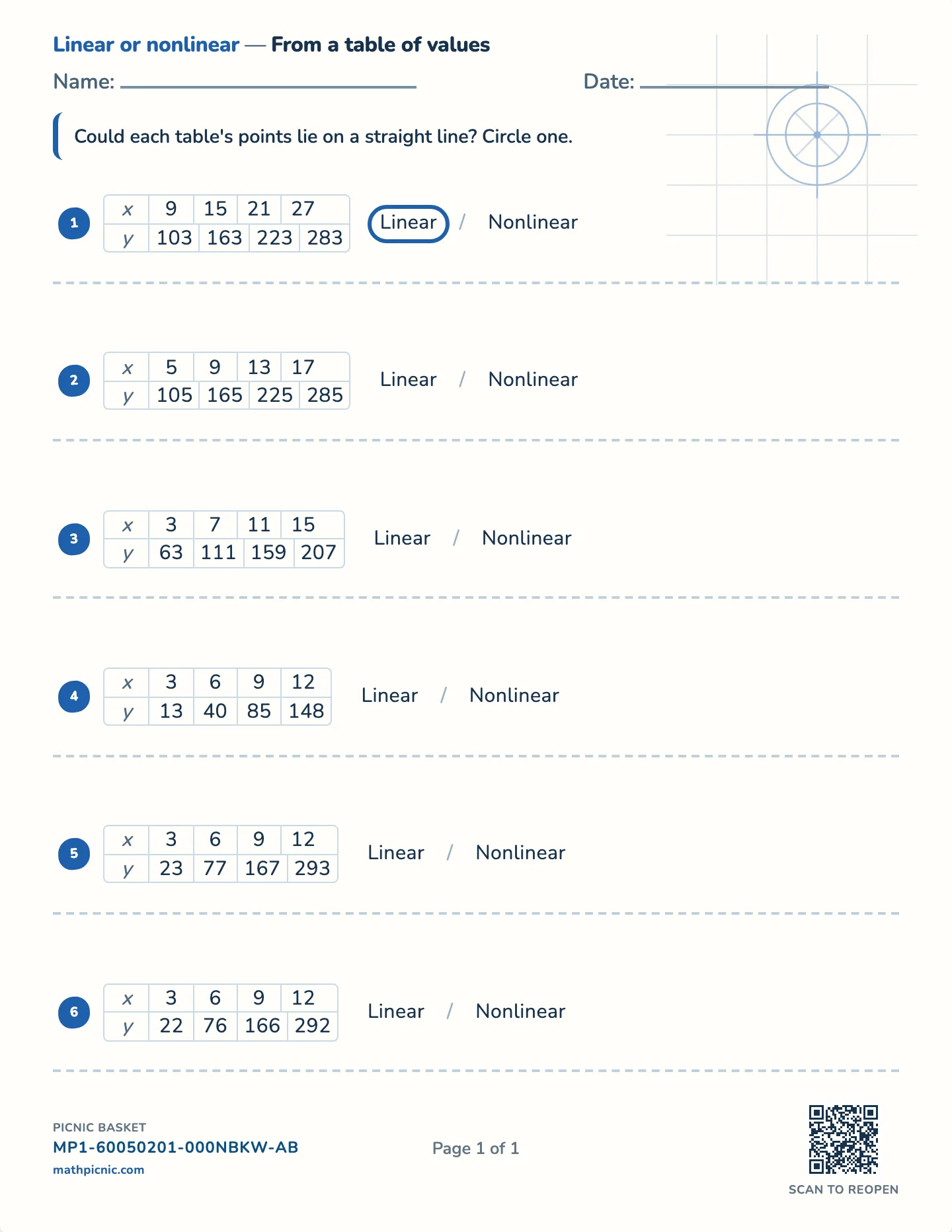
Linear from a table worksheets

A table is linear when equal steps in x bring equal steps in y. These free printable worksheets ask it of a table of values, where the answer is worked out rather than recognized.

Kid stuck on one? You don’t just get the sheet.

Linear from a table
Linear from a table worksheet — From a table, free printable with answer key

The answer key prints on a separate page.

What's on this sheet

The child takes the steps: x rises evenly, and then either y rises by the same amount every time — a straight line — or the gaps change and the points bend. That is the standard's argument carried out on numbers instead of recited, and it is why the table is a separate sheet from the equation one: there is no shape to spot, only a pattern to measure.

Why this sheet works

Every table here steps x evenly, on purpose. For x = 1, 2, 4 a real line gives y-steps of m and 2m, which look like they change even though the rule is straight — an unfair question that the standard does not ask. With the x-steps kept equal, a constant y-step means a line and a changing one means a curve, cleanly. Check the x column is even before reading y.

How this one works

One question from this sheet, worked through a step at a time.

x: 9, 15, 21, 27 y: 103, 163, 223, 283

x9152127y103163223283
x9152127steps666
y103163223283steps606060
Linear or nonlinear?Linear
  1. A straight line climbs by the same amount every time. So this is not a question about the numbers themselves — it is a question about the STEPS between them.
  2. First check the x row, because the rest only means anything if these are even: 6, 6, 6. Every step is 6, so the readings are evenly spaced.
  3. Now take the steps in y: 60, 60, 60.
  4. Every step is the same, so the points climb at one steady rate — they lie on a straight line. x goes up by 6 every time and y goes up by 60 every time.