The quadrilateral hierarchy worksheets

Every square is a rectangle. Every rectangle is not a square. Both sentences are true and a fifth-grader has to hold them at the same time \u2014 these free printable worksheets ask for always, sometimes or never, one statement at a time.

The quadrilateral hierarchy
The quadrilateral hierarchy worksheet — Squares, rectangles, rhombuses, parallelograms, free printable with answer key

The answer key prints on a separate page.

What's on this sheet

A quadrilateral has more than one name, and that is the whole of 5.G.B.4. A square is also a rectangle, also a rhombus, also a parallelogram, and none of those is a different shape from it \u2014 they are wider categories it sits inside. The question a child gets wrong is the one running the other way: every rectangle is not a square, because most rectangles are longer than they are wide.

Why this sheet works

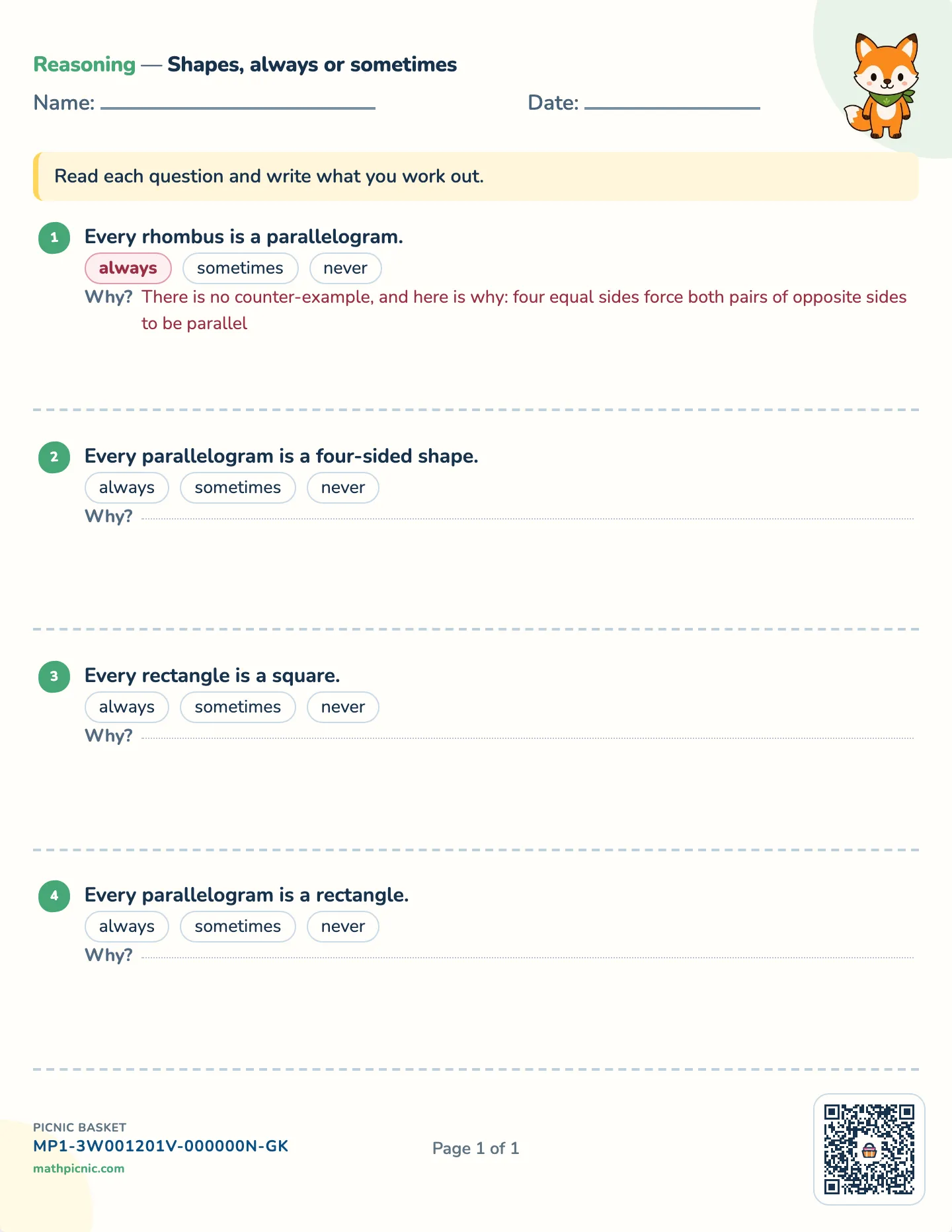
Each page prints a statement and three words. \u201cAlways\u201d means no shape in the category breaks it; \u201csometimes\u201d means at least one does and at least one does not; \u201cnever\u201d means none holds. A student who answers before reading gets about a third of them, which is why the page mixes the two directions of every pair \u2014 the sheet shows \u201cevery rhombus is a parallelogram\u201d and \u201cevery parallelogram is a rhombus\u201d, one word apart and two different answers.

How this one works

Every rhombus is a parallelogram.

Every rhombus is a parallelogram.
alwayssometimesnever
always
  1. Before trying anything, notice what each answer would COST. One example that works proves nothing at all. One that fails rules out "always" on its own. They are not the same size of evidence.
  2. So hunt for a counter-example — a case where the claim breaks. That is the cheapest question to ask, and its answer decides between all three.
  3. There is no counter-example, and here is why: four equal sides force both pairs of opposite sides to be parallel So the answer is always.