Math test
Name: Date:
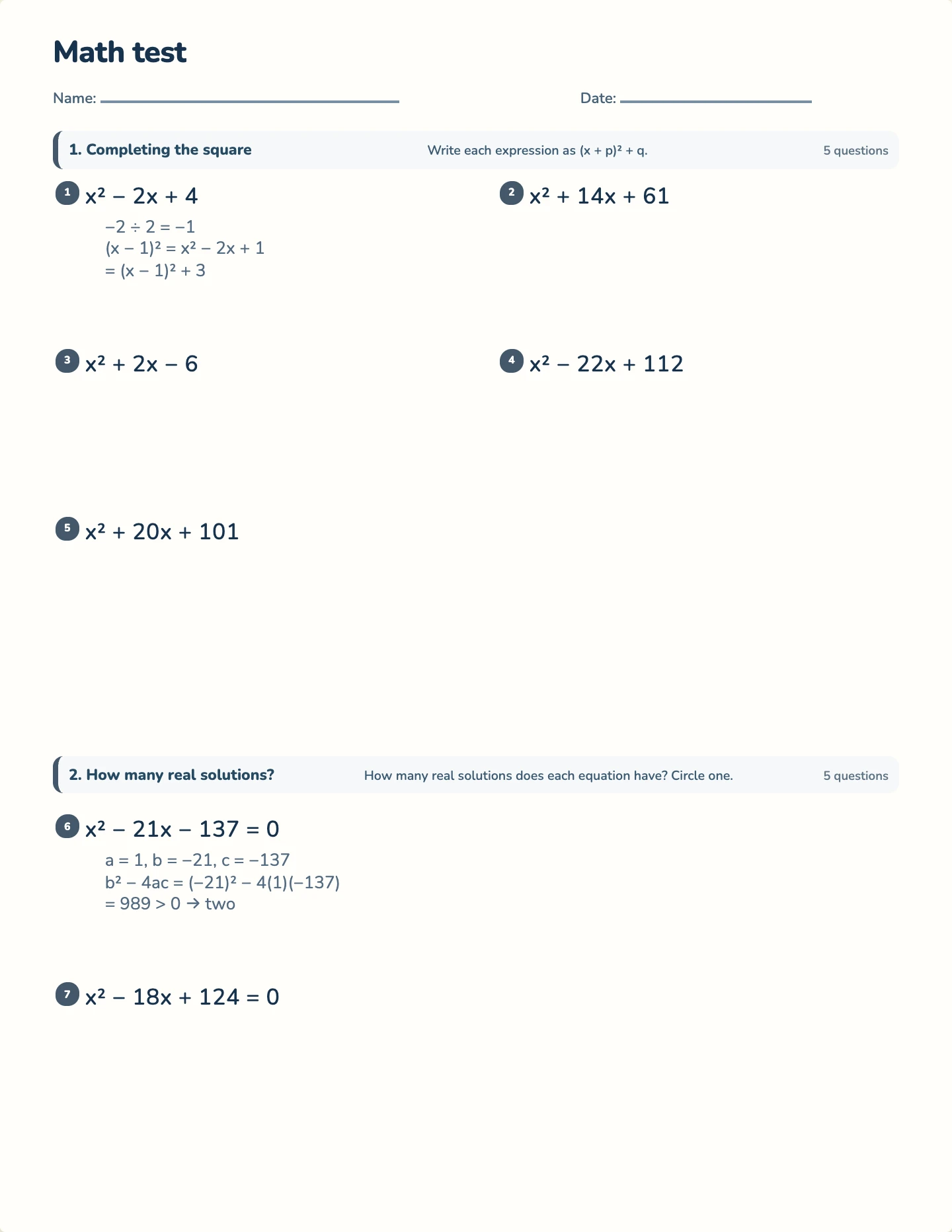
1. Completing the squareWrite each expression as (x + p)² + q.5 questions
1x² − 2x + 4
2x² + 14x + 61
3x² + 2x − 6
4x² − 22x + 112
5x² + 20x + 101

Where a quadratic runs out of real answers, and what happens next.
The answer key prints on a separate page.
The paper is built in the order the idea arrives. Completing the square rewrites a quadratic so its solutions can be read off, and the discriminant section then asks a different kind of question — not what the solutions are but how many there are. A negative discriminant is the door: the quadratic has no real solutions, and until this unit that was the end of the sentence.
The last section is what lies on the other side of it. Adding complex numbers is adding two things at once and keeping them apart; multiplying is four products and a sign rule, and the sign rule is the only new fact on the page — i² is −1, so the last product changes sign. The powers of i cycle every four, which is a question about remainders wearing an algebra costume, and a student who spots that finishes i²⁷ faster than one who writes out twenty-seven multiplications.