What's on this test
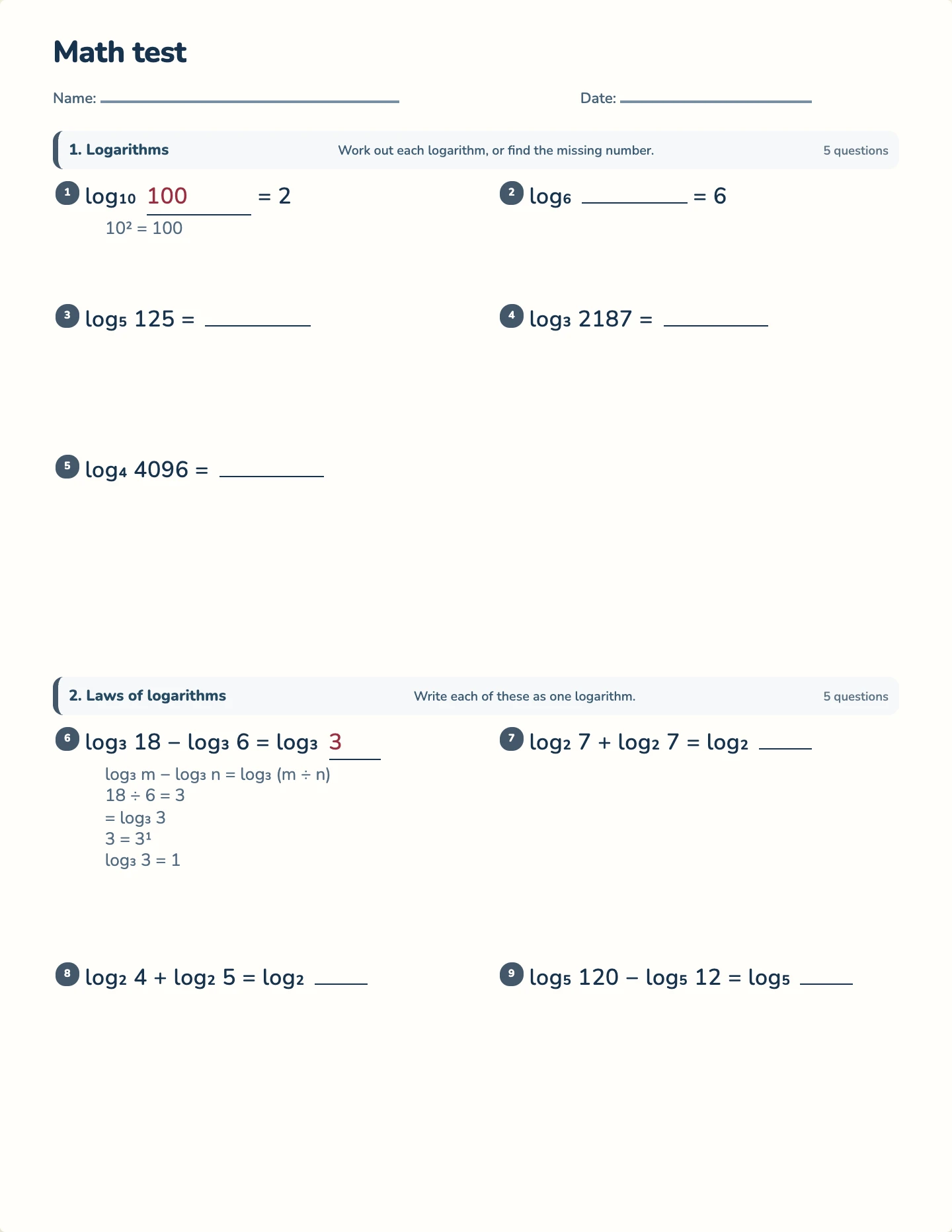
The first section asks both directions of the same fact: what is log₂ 32, and log₂ of what is 5. Students who have only met the first come unstuck on the second, and the gap is worth finding on a test rather than in an exam — it is usually a sign the definition has been memorized as a procedure rather than as a question about exponents. Negative answers appear on purpose: log₂ of 1/32 is −5, and reading that off a fraction is where the definition either holds or does not.
How the paper is put together
The middle section is the three laws, and none of its numbers is a power of the base. That is deliberate: log₅ 6 + log₅ 4 cannot be finished by evaluating each logarithm, so the law is the only road to the answer. A paper built from friendly powers can be passed without ever using a law. The last section turns to exponential functions, which is what logarithms are for — the two are the same relationship read in opposite directions, and a unit that never says so leaves the logarithm looking like a piece of notation.