Domain and rangeMixed, interval notation
Name: Date:
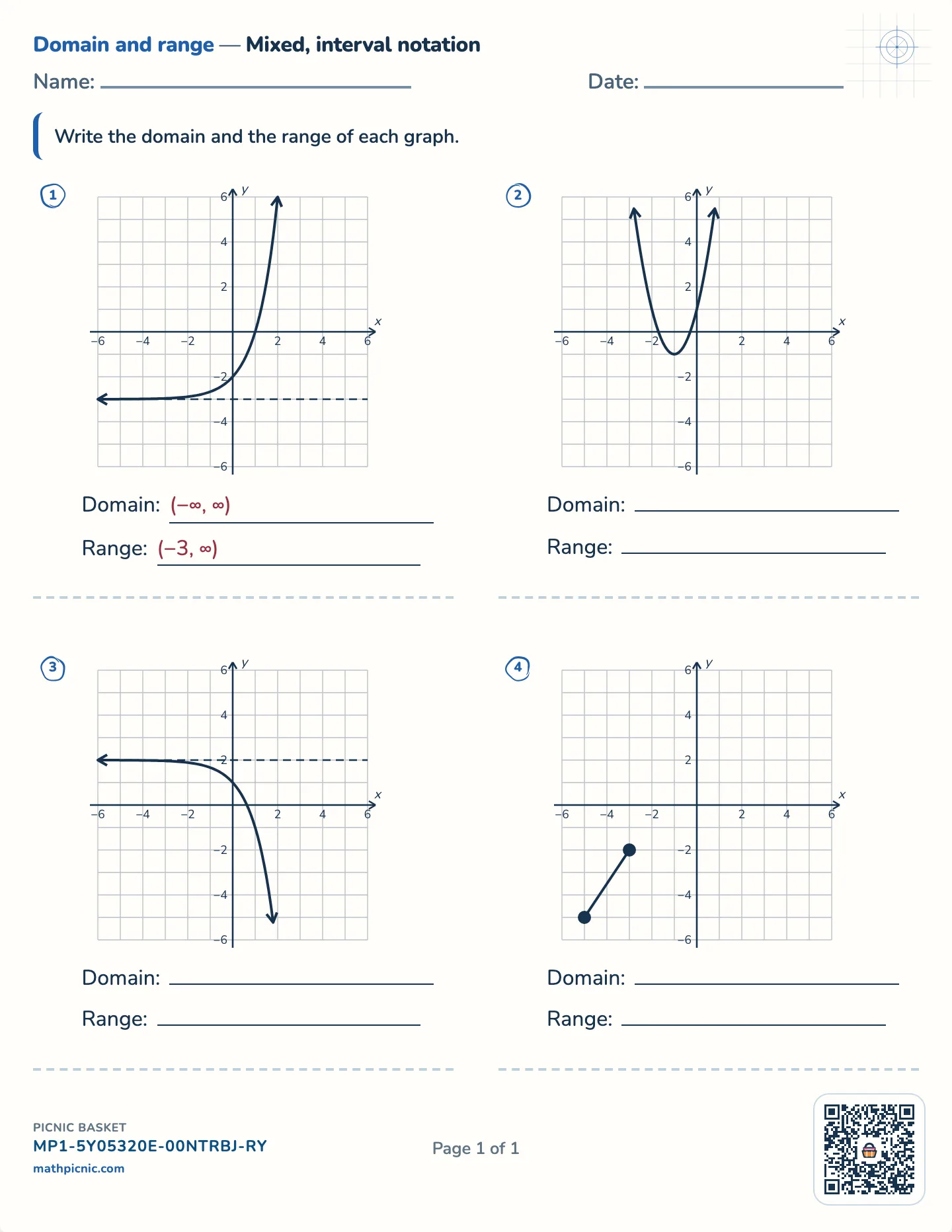
Write the domain and the range of each graph.
1Domain: Range:
2Domain: Range:
3Domain: Range:
4Domain: Range:

Interval notation says the same thing as an inequality in fewer marks. These free printable worksheets read the domain and range off a graph and write them with brackets and parentheses, with an answer sheet.
If they get stuck
The answer key prints on a separate page.
A square bracket means the end is included, and a parenthesis means it is not. So a segment from a filled dot at x = −1 to an open dot at x = 4 has the domain [−1, 4). The smaller number always goes first, because the interval is read from left to right along the number line.
Infinity always gets a parenthesis, since it is not a number the graph can reach. A range that starts at −3 and keeps going up is [−3, ∞), and all real numbers is (−∞, ∞). Students sometimes want to write a bracket next to infinity, and asking whether the graph ever gets there is usually enough to settle it.
The exponential on the grid