Rational equationsBoth forms
Name: Date:
Solve each equation for x.
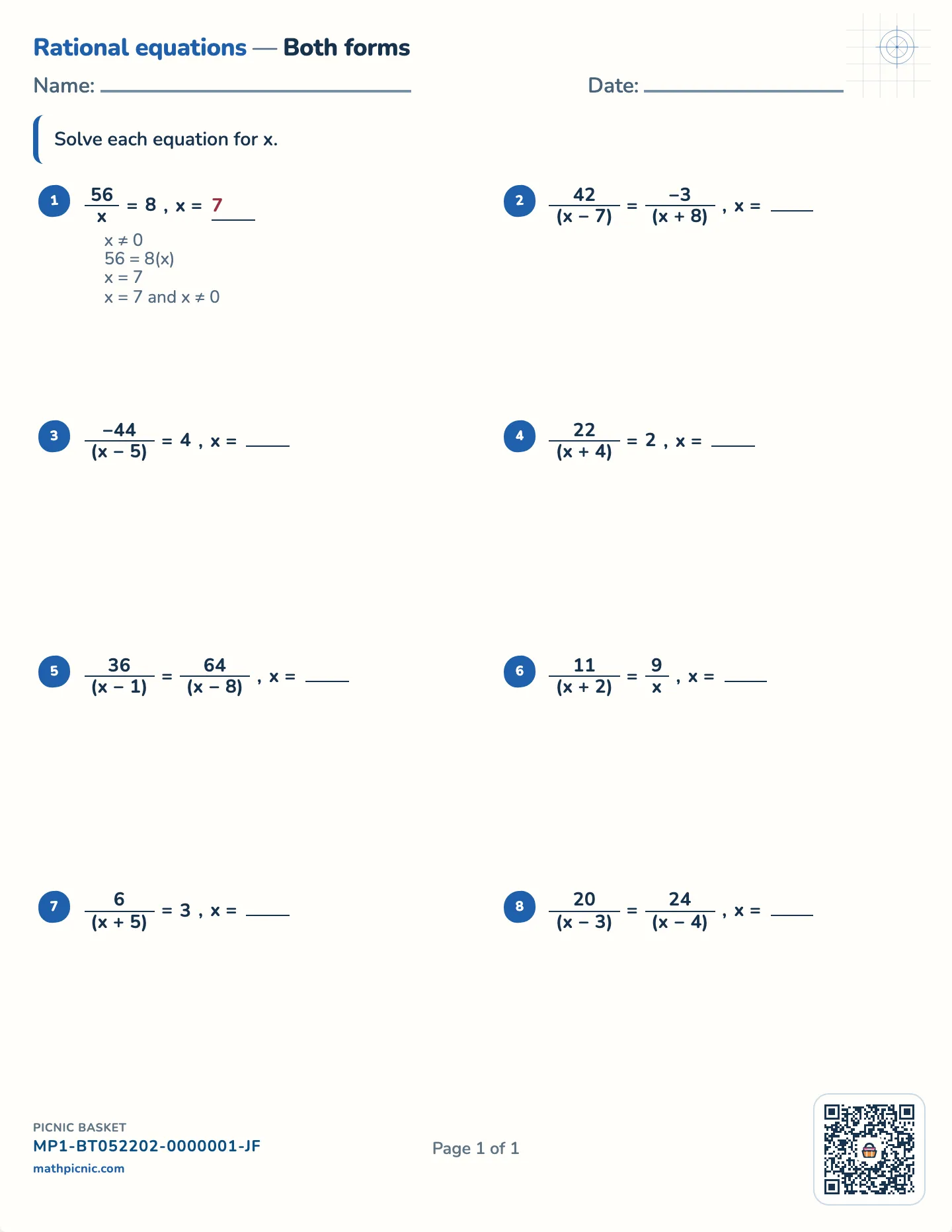
156x8x =
242(x − 7)−3(x + 8)x =
3−44(x − 5)4x =
422(x + 4)2x =
536(x − 1)64(x − 8)x =
611(x + 2)9xx =
76(x + 5)3x =
820(x − 3)24(x − 4)x =

A rational equation has x in a denominator, and the first move is to get it out: multiply both sides by what is underneath. These free printable worksheets mix the two forms a course meets first, one fraction equal to a number and one fraction equal to another, and every answer is a whole number.
If they get stuck
The answer key prints on a separate page.
With one fraction, 12/(x + 3) = 4 becomes 12 = 4(x + 3), which is a linear equation a student has solved a hundred times. With a fraction on each side, 6/(x + 1) = 3/(x − 2) becomes 6(x − 2) = 3(x + 1) — cross-multiplying is the same move done to both denominators at once, and the key writes the cleared equation on its own line so that the step is visible rather than assumed.
The step a rational equation adds is the check at the end. A denominator may never be zero, so x = −3 can never solve anything with x + 3 underneath it, whatever the algebra says. Every answer on these sheets is a legal one, and the key still names the value each denominator forbids and confirms the answer is not it — a habit is only built by doing it when it passes.
56/x = 8