Solving equationsTo 50
Name: Date:
Solve each equation for x.
18x + 5 = 7x + 9
25x + 1 = 2x + 13
32x + 17 = 5x + 14
48x + 6 = 7x + 11
54x + 18 = 7x + 12
64x + 8 = 9x + 3

5x + 3 = 2x + 18 is the first equation that needs a decision before it needs arithmetic. These free printable worksheets practice collecting the x terms and then solving.
If they get stuck
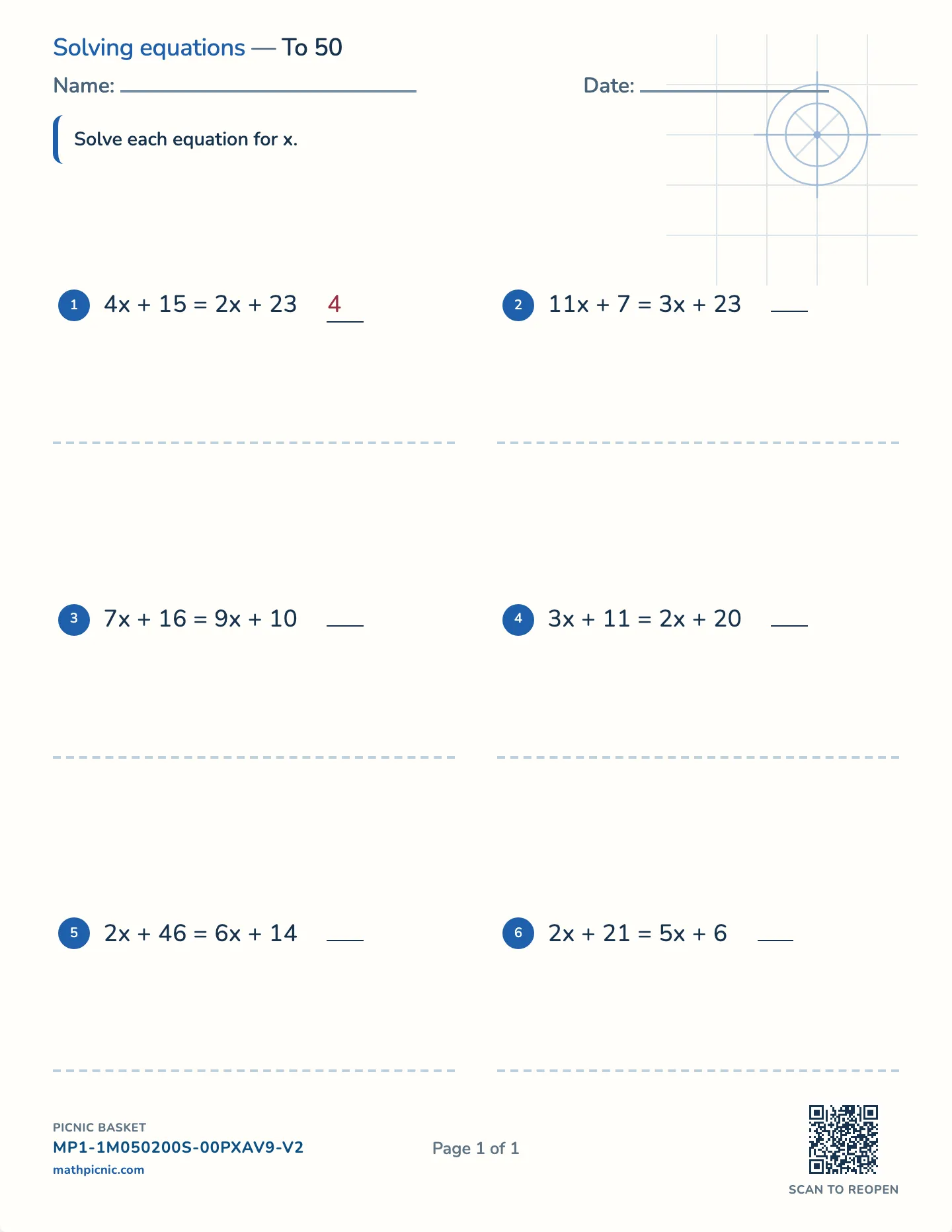
The answer key prints on a separate page.
Every equation before this one has x in a single place, so the only question is what to undo. Here a child who starts by subtracting the 3 has not done anything wrong — they have just done it in an order that leaves them no better off, because there is still an x on the other side. Collecting the x terms first is the new move, and once it is done the equation is a two-step one they have already met.
Both orientations are on every sheet on purpose. 5x + 3 = 2x + 18 collects on the left and 2x + 18 = 5x + 3 collects on the right, and a page of only the first teaches "always move the right one over" — a rule that breaks on the first mirrored equation a textbook prints. Deciding which side to collect on is the skill.
One question from a sheet like this one, worked a step at a time — with a sentence saying what just happened and why.
Variables on both sides, step by step