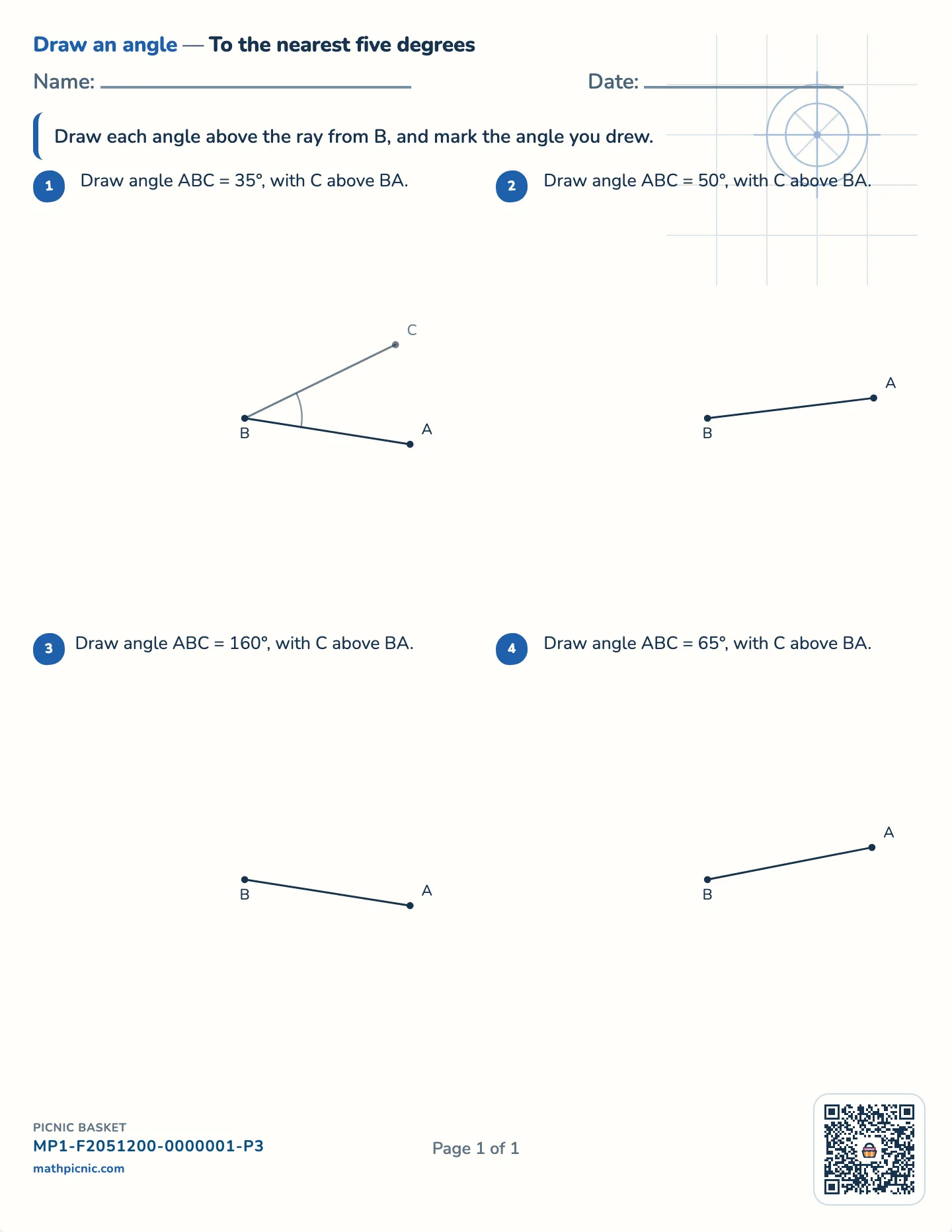
Setting a protractor is harder than reading one: the child chooses where to start counting, and a single wrong scale turns a 50° angle into a 130° one. A ray is given on each question and the angle is built above it.
Reading a protractor is following an instruction; setting one is a decision. A child drawing a 50° angle has to put the tool's origin on the vertex, its zero line along the given ray, and then count from the zero that belongs to that ray — the other scale is right there and gives 130°. That single choice is what these sheets practise.
Why this sheet works
Each question gives the ray and asks for the angle ABOVE it, and the wording matters more than it looks. Without it the question has two right answers: an angle turned one way and the same angle turned the other are both angle ABC, so a child who turned the other way would have done the mathematics correctly and been marked wrong. The given ray runs along the bottom of each figure and the instruction names the side, so the sheet and its key agree.
How this one works
One question off this sheet, worked a step at a time — with a sentence saying what just happened and why.
Draw each angle above the ray from B, and mark the angle you drew.
1Draw angle ABC = 35°, with C above BA.
2Draw angle ABC = 50°, with C above BA.
3Draw angle ABC = 160°, with C above BA.
4Draw angle ABC = 65°, with C above BA.
Draw an angle · To the nearest five degreesAnswer key
1. Draw angle ABC = 35°, with C above BA. The second arm is 35° from BA.2. Draw angle ABC = 50°, with C above BA. The second arm is 50° from BA.3. Draw angle ABC = 160°, with C above BA. The second arm is 160° from BA.4. Draw angle ABC = 65°, with C above BA. The second arm is 65° from BA.