Measure an angleTo the nearest five degrees
Name: Date:
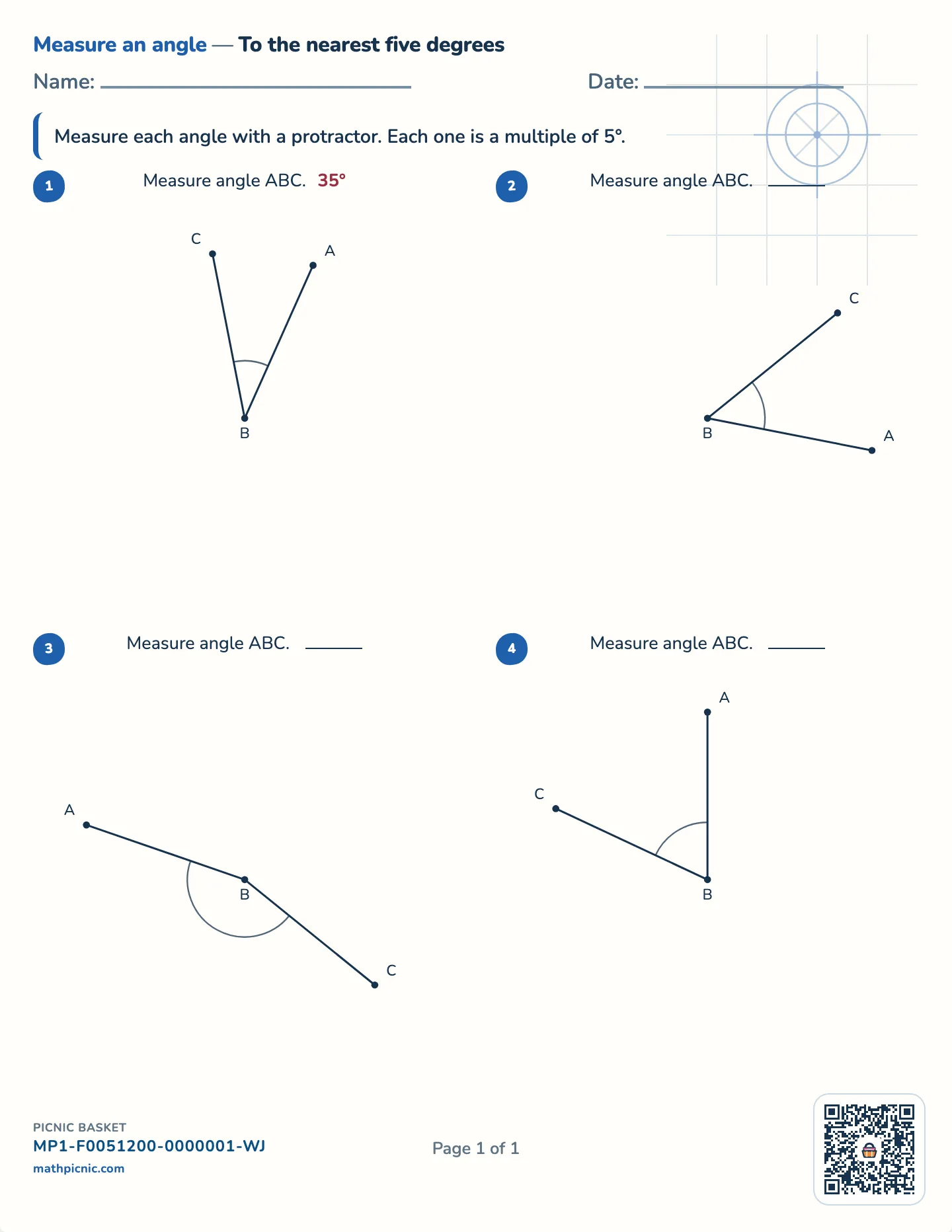
Measure each angle with a protractor. Each one is a multiple of 5°.
1Measure angle ABC.
2Measure angle ABC.
3Measure angle ABC.
4Measure angle ABC.

Reading a protractor is two skills a child learns at once: lining the tool up on the vertex and the baseline, and then choosing which of its two scales to read. These sheets turn every angle a different way, because an angle sitting flat on the page can be guessed at without the tool.
If they get stuck
The answer key prints on a separate page.
The hard part of a protractor is not the arithmetic, it is the inner and outer scale. A protractor prints two rows of numbers running opposite ways, so the same mark reads 60 and 120 depending on which arm you started from — and a child who has only met angles drawn along the bottom of the page never has to choose. Every angle here stands at its own rotation, so the choice has to be made each time.
The arms are drawn 38mm long, and that is a real constraint rather than a style. A protractor's scale sits about 45mm from its origin, so an angle whose arms stop short leaves the scale hanging in white space and the child has to extend the lines with a ruler before measuring anything. That is a genuine skill and it is not the one this sheet is about, so the figures are printed at true size and a browser check measures every one of them before the page ships.
One question off this sheet, worked a step at a time — with a sentence saying what just happened and why.
Measuring angles with a protractor, step by step