Measure an angleReflex angles
Name: Date:
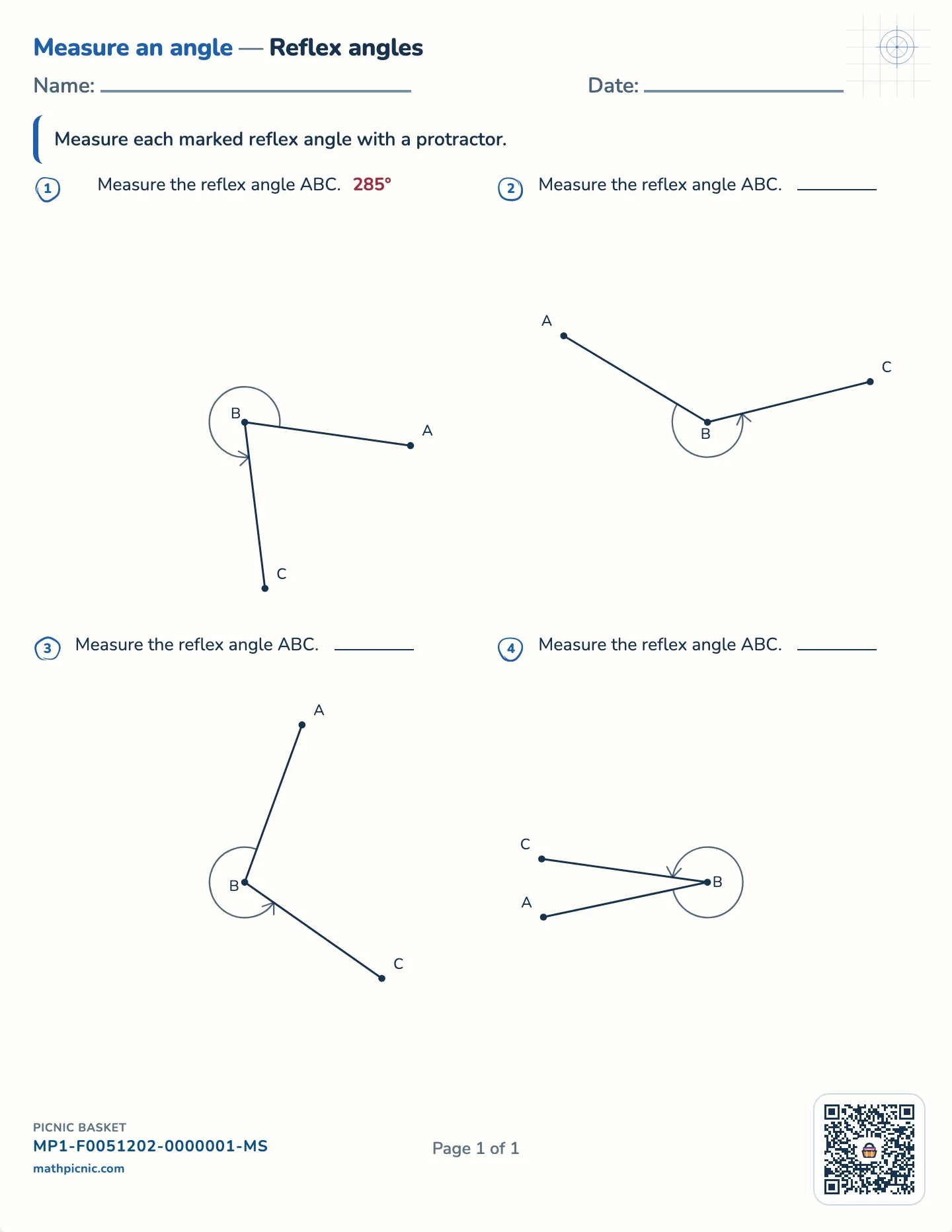
Measure each marked reflex angle with a protractor.
1Measure the reflex angle ABC.
2Measure the reflex angle ABC.
3Measure the reflex angle ABC.
4Measure the reflex angle ABC.

A protractor stops at 180°, and every angle on this sheet is bigger than that. So these free printable worksheets ask for something a little more than reading a scale: measure the part you can reach, and then work out the rest.
If they get stuck
The answer key prints on a separate page.
Each figure is two arms from a point B, with an arc going the long way around. The arc is what makes it a reflex angle. Without it, the same two arms would simply show the smaller angle between them, and that is the angle most children will measure first if they are not looking at the arc.
There are two good ways to get the answer. One is to measure the small angle on the other side and take it from 360°, so a small angle of 75° means the reflex angle is 285°. The other is to measure past the straight line, reading 180° and then adding the piece left over. Both are worth trying once, and getting the same answer both ways is a good check.
Measure a reflex angle