Figure perimeterParallelograms
Name: Date:
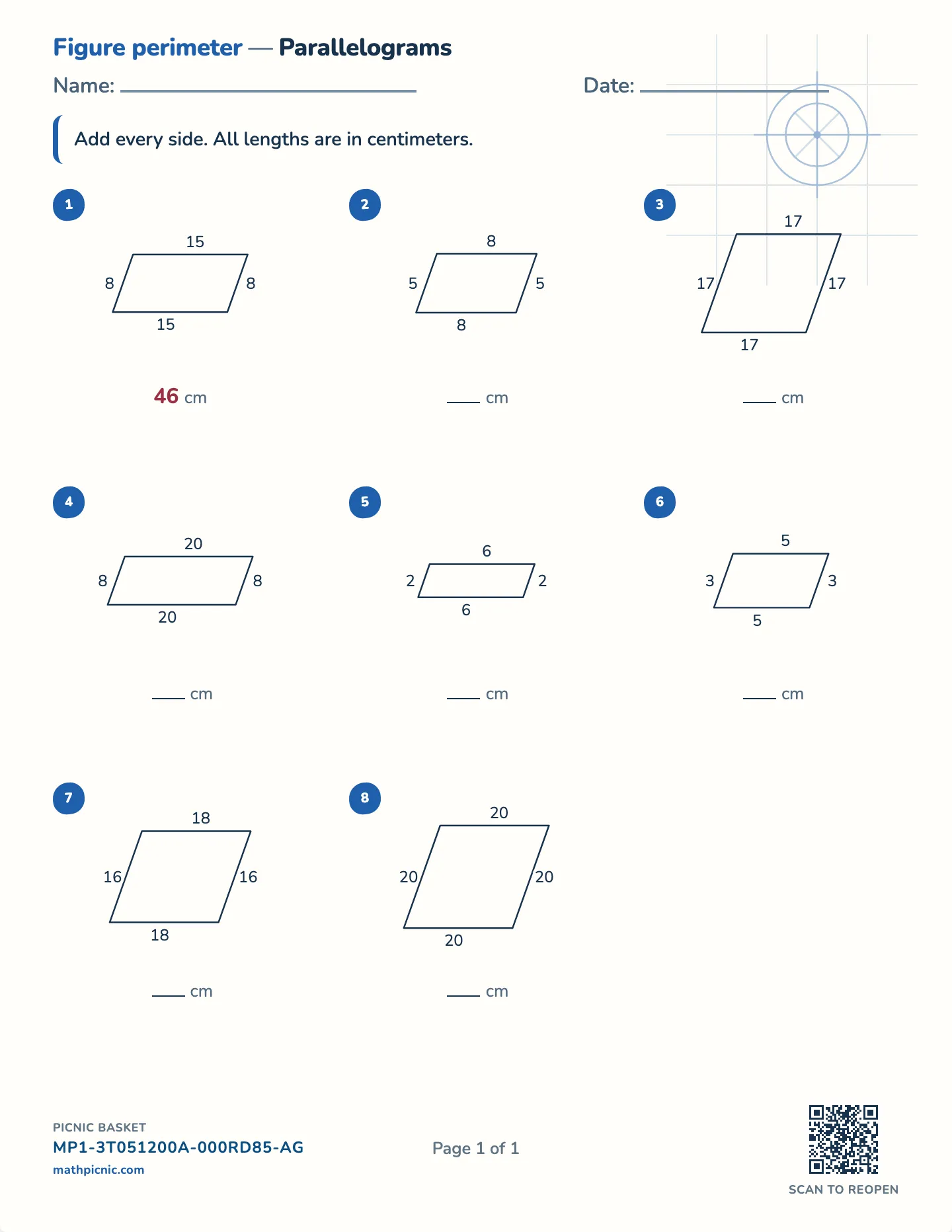
Add every side. All lengths are in centimeters.
1 cm
2 cm
3 cm
4 cm
5 cm
6 cm
7 cm
8 cm

A parallelogram has two pairs of equal sides, so its perimeter is twice one side plus twice the other — you only need two of the four numbers. These free printable worksheets drill that one shape.
If they get stuck
The answer key prints on a separate page.
Pulled out of the mixed perimeter page, the parallelogram is the shape that teaches a child to use the figure's structure instead of adding blindly. Opposite sides are equal, so two measurements settle all four.
Both distinct lengths are labeled and the figure is drawn true, so the long sides really are the long sides. A child can add all four sides and get the right answer, or add the two different ones and double — and noticing that those give the same total is the point of the sheet.
One question from a sheet like this one, worked a step at a time — with a sentence saying what just happened and why.
Perimeter of a parallelogram, step by step