Figure perimeterTriangles
Name: Date:
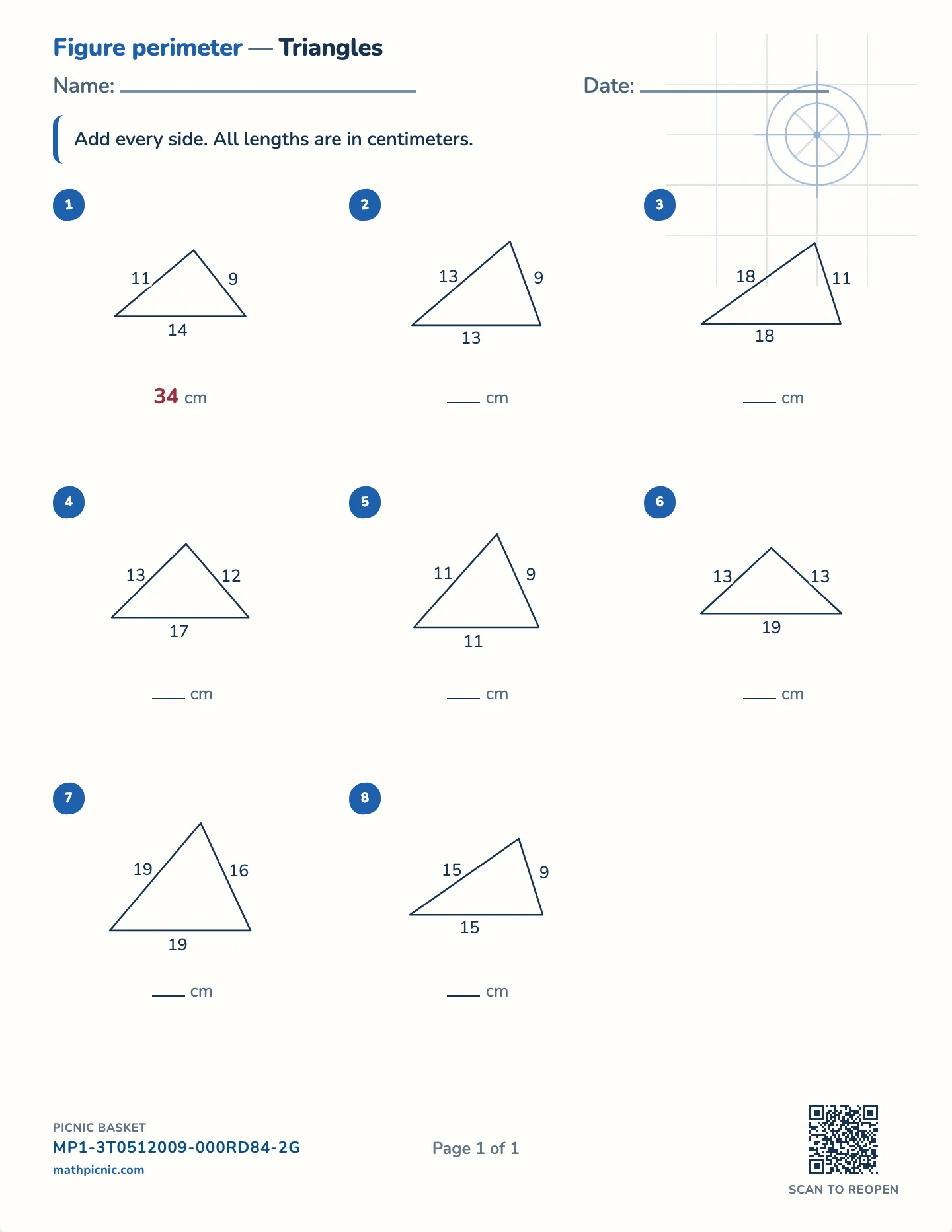
Add every side. All lengths are in centimeters.
1 cm
2 cm
3 cm
4 cm
5 cm
6 cm
7 cm
8 cm

A triangle's perimeter is the distance around it: add the three sides. These free printable worksheets label every edge, including the slanted ones, so all three numbers count toward the answer.
If they get stuck
The answer key prints on a separate page.
This is the triangle taken out of the mixed perimeter page, which rotates through triangles, parallelograms, trapezoids, and rectangles. On its own it is a clean three-number addition, which is where a child starting perimeter should begin.
Every side carries its own number — the opposite of the area sheets, where slant sides are deliberately left blank. Here a blank edge would make the figure unanswerable, so all three are printed, and the triangle is drawn to match them: sides of 14, 13, and 17 are drawn as exactly that triangle.
One question from a sheet like this one, worked a step at a time — with a sentence saying what just happened and why.
Perimeter of a triangle, step by step