Surface areaUnfolded nets
Name: Date:
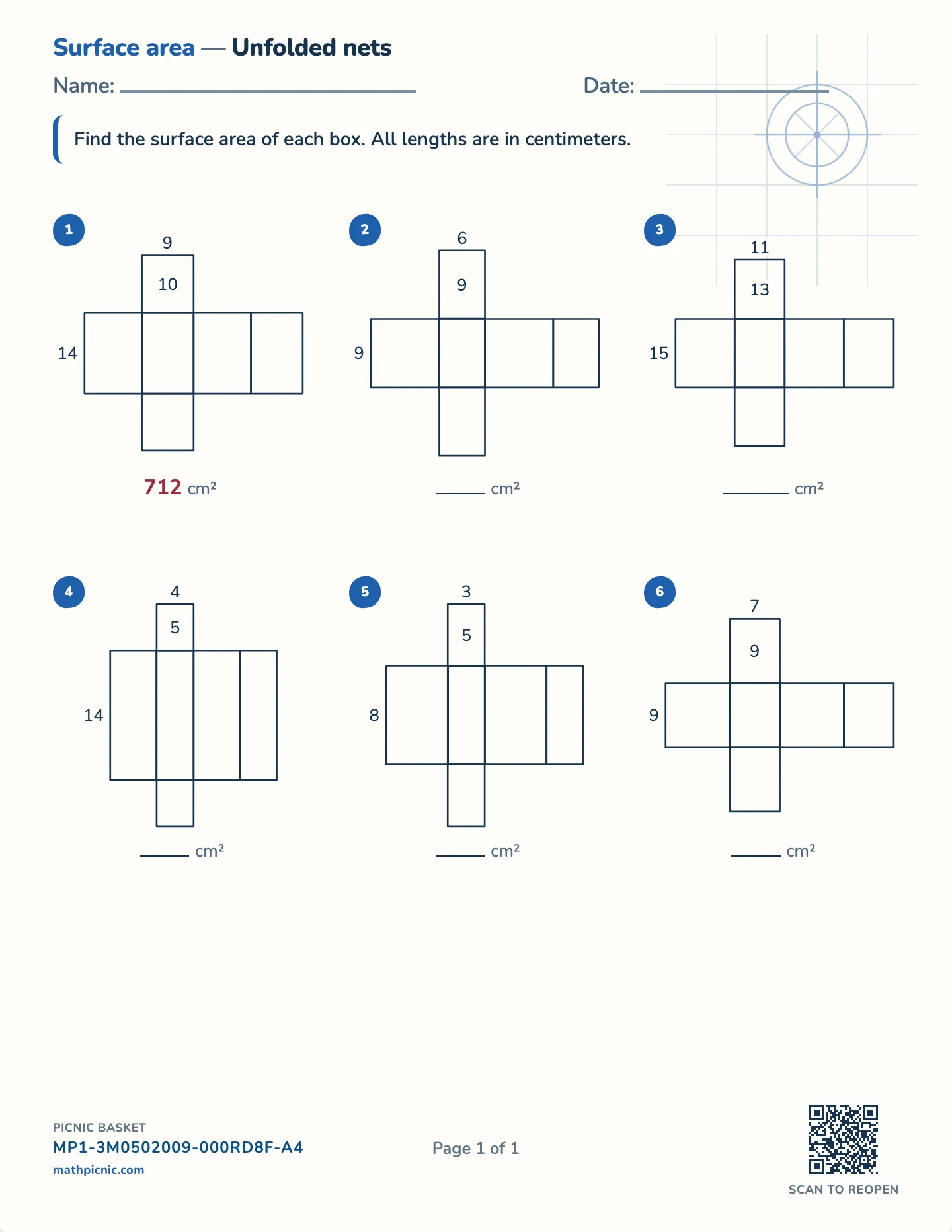
Find the surface area of each box. All lengths are in centimeters.
1 cm²
2 cm²
3 cm²
4 cm²
5 cm²
6 cm²

A net is a box laid flat, and every one of its faces is out in the open where a child can point at it. These free printable worksheets show only the unfolded net and ask for the surface area — the on-ramp to the standard before the closed solid arrives.
If they get stuck
The answer key prints on a separate page.
The mixed surface-area sheets alternate between the solid and the net; this one never draws the closed box at all. That is the whole point of it. A child who cannot yet hold three hidden faces in their head does not have to: all six rectangles are drawn flat, and the work is to see them as three matching pairs and add.
Only three edge lengths are printed on the cross, because that is what a box has, and the six faces are built from them. Front and back share a size, left and right share a size, top and bottom share a size — noticing that is what turns a long six-rectangle addition into 2(wd + wh + dh). Children fresh from volume will reach to multiply all three numbers together, and the flat figure is the clearest place to catch that.
One question from a sheet like this one, worked a step at a time — with a sentence saying what just happened and why.
Surface area from a net, step by step