Interquartile range worksheets

The range measures the whole spread; the interquartile range measures the spread of the middle half, where most of the data sits. These free printable worksheets give seven numbers and ask for the IQR — worked so every quartile is a whole number.

Kid stuck on one? You don’t just get the sheet.

Interquartile range
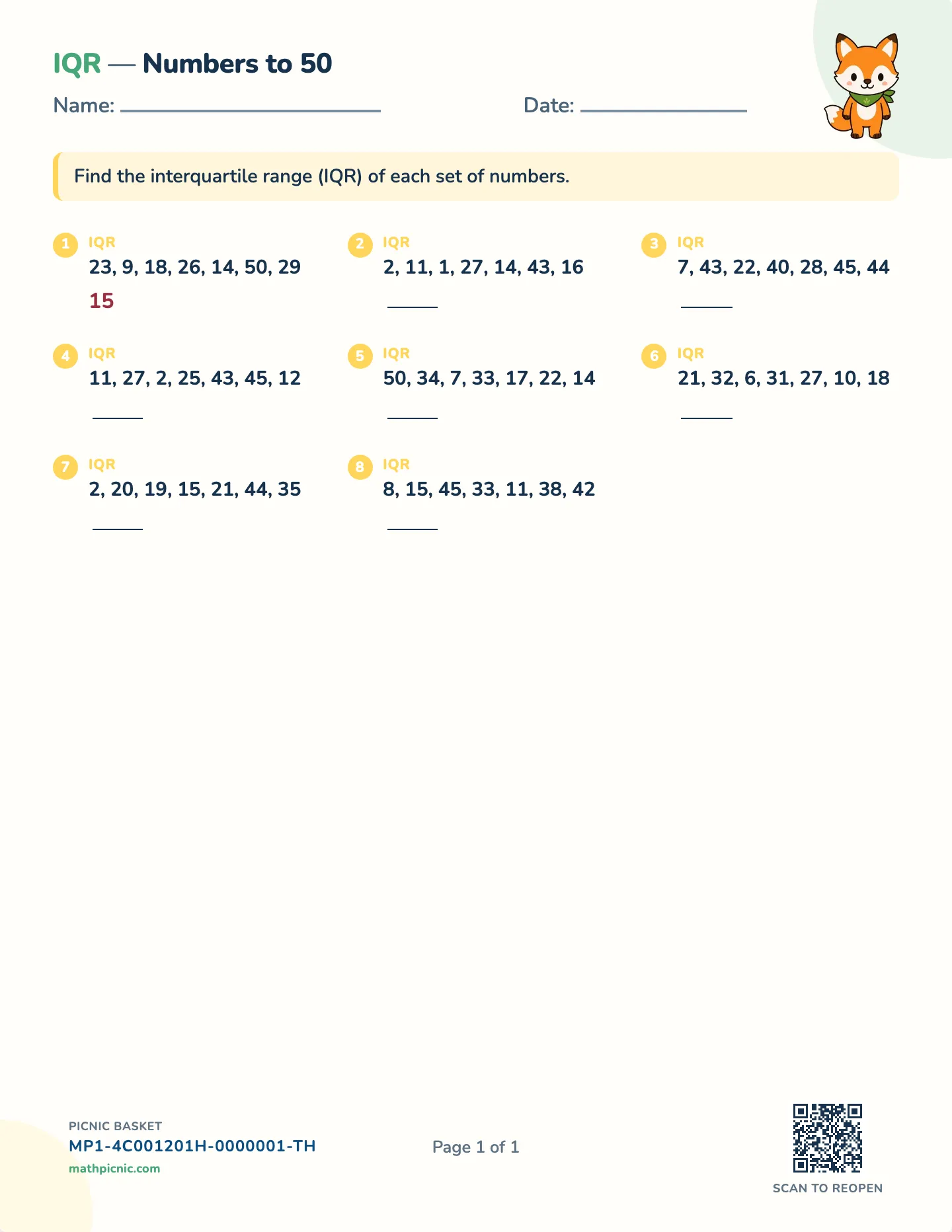
Interquartile range worksheet — Seven numbers, whole-number quartiles, free printable with answer key

The answer key prints on a separate page.

What's on this sheet

The method is order, split, subtract. Put the seven numbers in order, cross out the one in the middle to leave a lower half and an upper half, and the middle of each half is a quartile: Q1 below, Q3 above. The interquartile range is Q3 minus Q1. Saying it as "the middle of the bottom, the middle of the top, the gap between them" is what keeps it from blurring into the plain range.

Why this sheet works

Seven numbers is deliberate, not arbitrary. With an odd half on each side, Q1 and Q3 land on actual data values rather than halfway between two — so the quartiles and the IQR are whole numbers, and a sixth-grader is never asked to write 12.5 in a blank meant for a whole. It is the same reason the mean sheets build their totals to divide evenly.

How this one works

One question from this sheet, worked through a step at a time.

IQR of 23, 9, 18, 26, 14, 50, 29

given:2391826145029
sorted:9141823262950
Q1 = 14Q3 = 29
Q1 = 14Q3 = 29
2914=15
  1. The interquartile range is the spread of the MIDDLE half. First put the numbers in order.
  2. Cross out the middle number, 23, to split the rest into a lower half and an upper half.
  3. The middle of the lower half is Q1 = 14, and the middle of the upper half is Q3 = 29.
  4. The IQR is the distance between them: 29 − 14 = 15.