MADNumbers to 50
Name: Date:
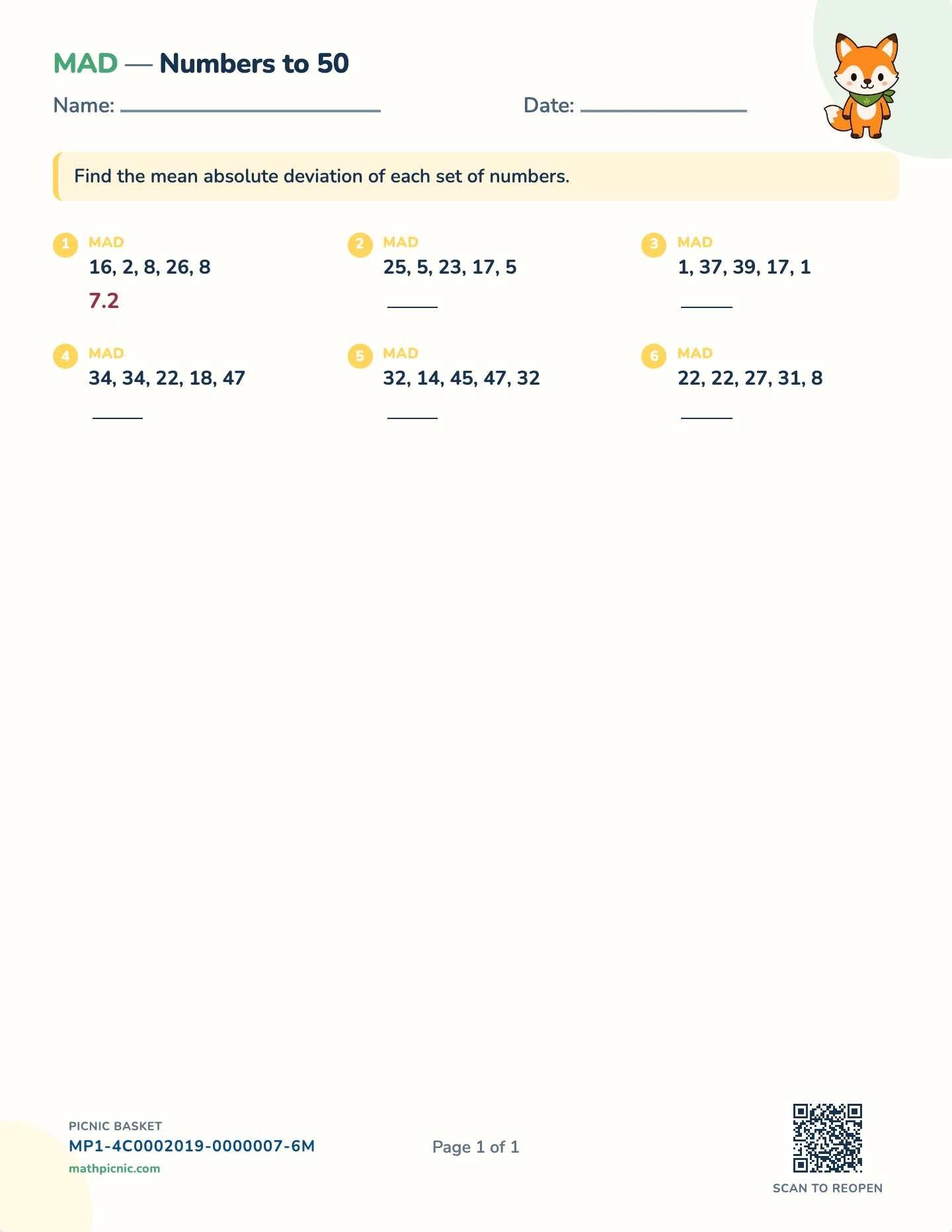
Find the mean absolute deviation of each set of numbers.
1
16, 2, 8, 26, 8
2
25, 5, 23, 17, 5
3
1, 37, 39, 17, 1
4
34, 34, 22, 18, 47
5
32, 14, 45, 47, 32
6
22, 22, 27, 31, 8

The mean says where a set of numbers sits; the mean absolute deviation says how spread out they are around it. These free printable worksheets ask for that spread, worked from a whole-number mean so the answer is always one clean decimal.
If they get stuck
The answer key prints on a separate page.
MAD is a mean of a mean, and saying it in that order is what makes it stick. First find the ordinary mean. Then, for each number, its distance from that mean — the size of the gap, with the sign thrown away, because a number three below is as far off as one three above. Then the mean of those distances. A child who tries to hold all three steps at once gets lost; a child who does them in order does not.
Every set here is built so the mean is a whole number, which is not a convenience but the thing that makes the sheet answerable. A mean absolute deviation is a fifth of a whole number, so it always lands on a single decimal place — 2.4, or 8, never 2.4666. A set of five free numbers would ask a sixth-grader for a repeating decimal with nowhere to write it, so the total is built to divide by five, the same backward construction the mean-median-mode sheets use.
One question from a sheet like this one, worked a step at a time — with a sentence saying what just happened and why.
Mean absolute deviation, step by step