Reading a graph worksheets

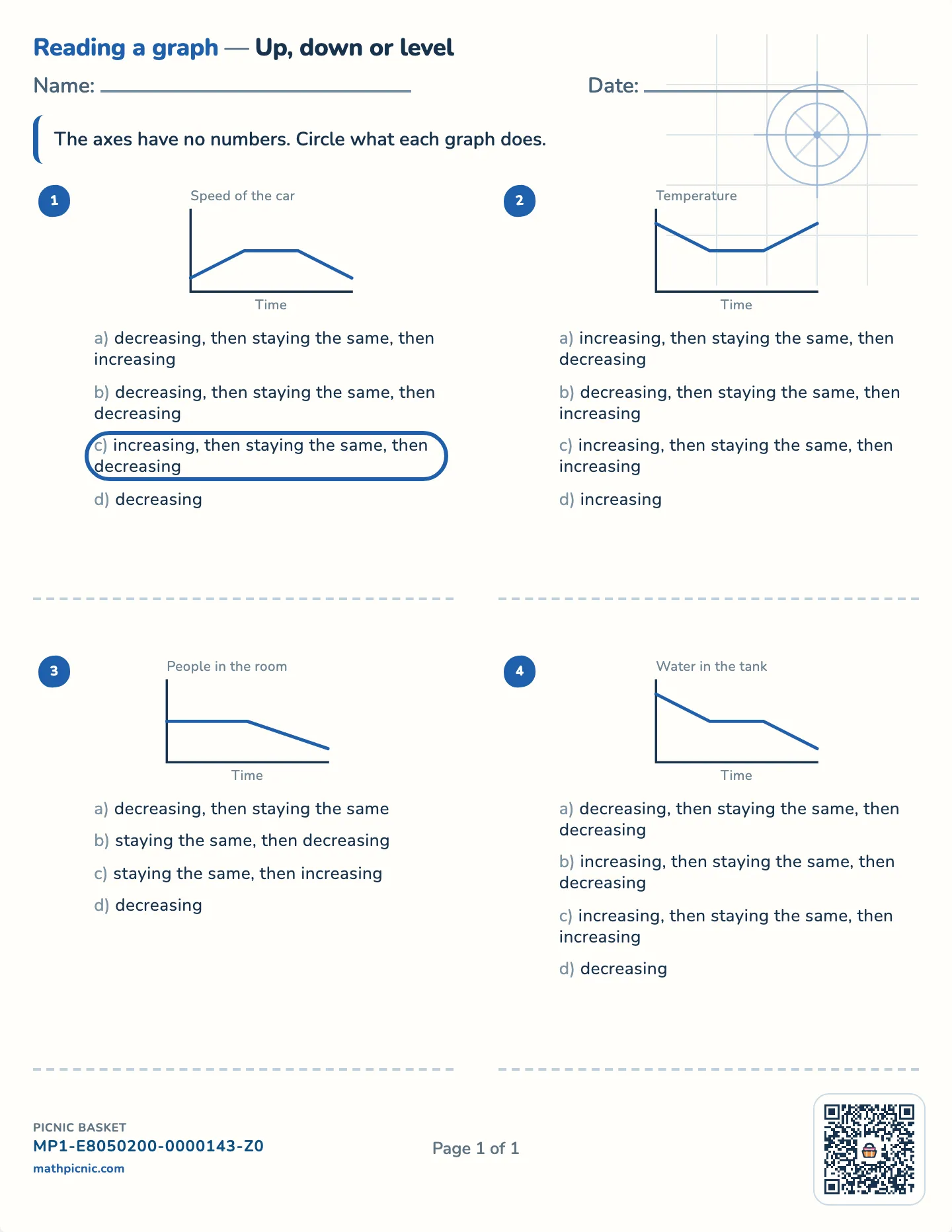
These graphs have no scale on them, and that is the question. With numbers on the axes a student can read a value across; with none, the only thing on the page is the SHAPE — which is what 8.F.B.5 asks for.

Reading a graph
Reading a graph worksheet — No scale on the axes, free printable with answer key

The answer key prints on a separate page.

What's on this sheet

Every other graph on this site is answered by reading a value off it. This one cannot be, on purpose. A scale would turn “is it increasing?” into “is 40 bigger than 20?”, which is arithmetic a second-grader has, and the standard would be met by nobody.

Why this sheet works

The wrong answers are real misreadings, not random phrases. Every question offers the run REVERSED — the mistake a child makes reading right to left — and the run with its first move flipped. A bank of unrelated shapes would let the answer be found by elimination without looking at the picture twice.

How this one works

Up, down or level

start at the leftfollow the line
1. climbs2. stays level3. falls
increasing, then staying the same, then decreasing
  1. There are no numbers on the axes, so there is nothing to read off — the shape is the whole answer. Put a finger at the left end of the line.
  2. Trace it across and count the pieces where it changes: there are 3. The line climbs, then stays level, then falls.
  3. "climbs" is what increasing means, so this graph is increasing, then staying the same, then decreasing.