Prime or compositeNumbers to 50
Name: Date:
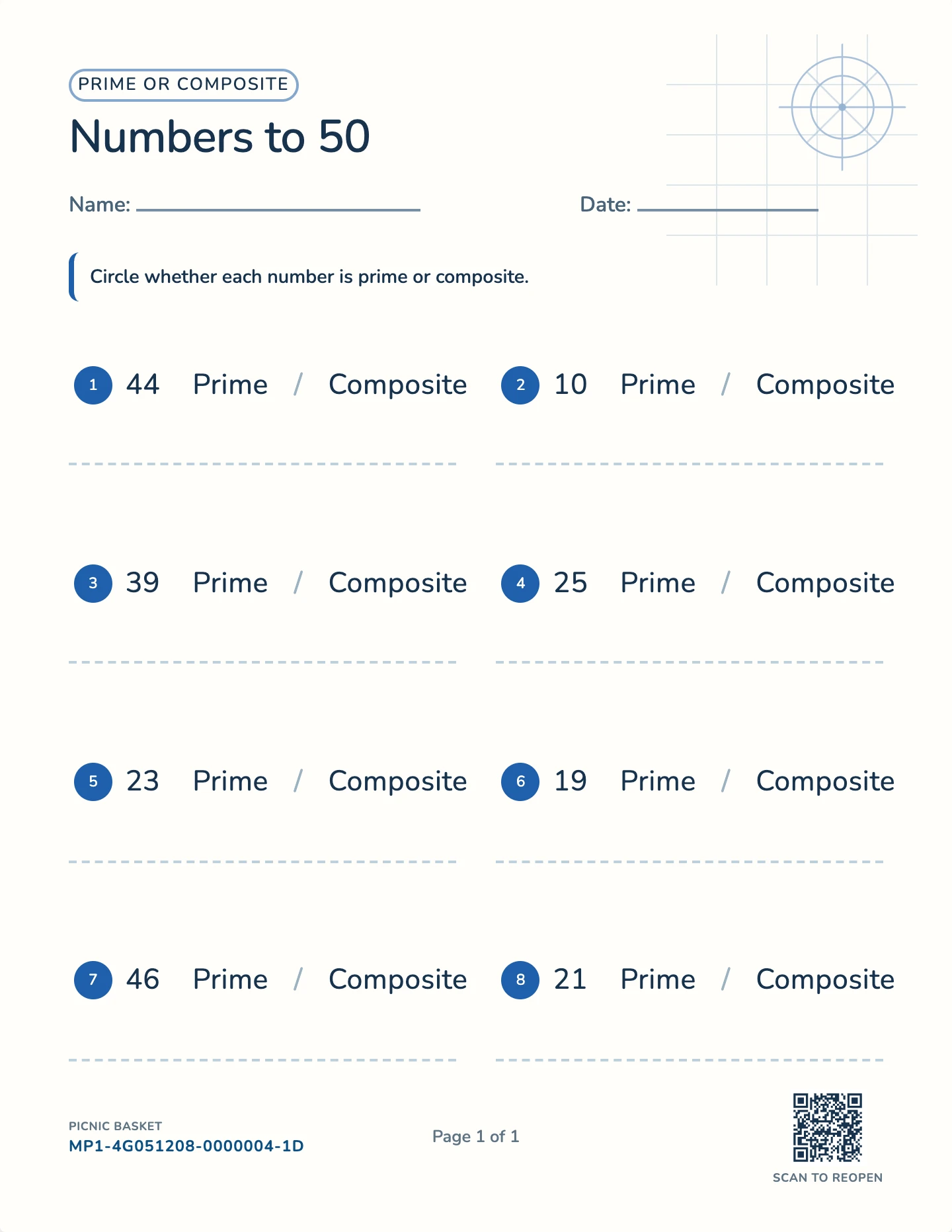
Circle whether each number is prime or composite.
144PrimeComposite
210PrimeComposite
339PrimeComposite
425PrimeComposite
523PrimeComposite
619PrimeComposite
746PrimeComposite
821PrimeComposite

A prime number has exactly two factors: one and itself. Everything else above one is composite. These free printable worksheets give a number and ask which it is, with an answer key that shows the factor that settles each composite.
If they get stuck
The answer key prints on a separate page.
The sheets are built to defeat the shortcut, which is the only interesting thing about designing them. Every prime except 2 is odd, so a page whose composites are all even numbers can be answered at speed by a child who has learned nothing: call the evens composite, call the odds prime, score nearly full marks. So the odd composites are drawn as their own group and every page contains some — 9, 15, 21, 25, 33, 35, 49 are the numbers that make this a real question, and a sheet without them is testing odd and even while calling it primality.
The band is the difficulty, and it is not just about bigger numbers. Up to 30, a composite gives itself away to the 2, 3 and 5 times tables. Past 50 the sheet starts asking about 91 and 97, where the only honest method is dividing by each prime up to the square root — and testing every candidate up to 100 is exactly the range the standard names.
Is 44 prime?