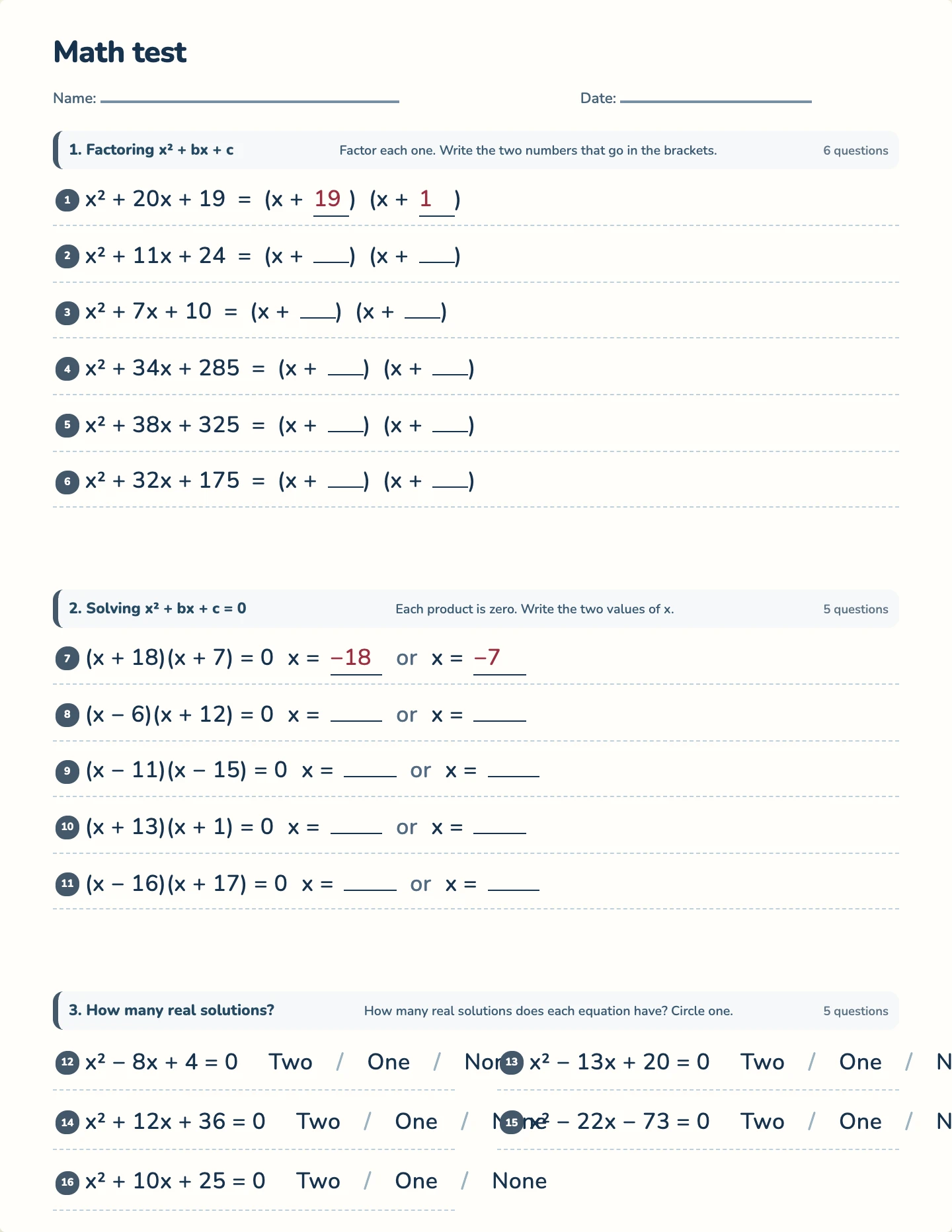
Factoring x² + bx + c
1. x² + 20x + 19 = (x + 19)(x + 1) (19 and 1)2. x² + 11x + 24 = (x + 3)(x + 8) (3 and 8)3. x² + 7x + 10 = (x + 2)(x + 5) (2 and 5)4. x² + 34x + 285 = (x + 15)(x + 19) (15 and 19)5. x² + 38x + 325 = (x + 13)(x + 25) (13 and 25)6. x² + 32x + 175 = (x + 25)(x + 7) (25 and 7)
Solving x² + bx + c = 0
7. (x + 18)(x + 7) = 0 → (x + 18)(x + 7) = 0 → x = −18 or x = −78. (x − 6)(x + 12) = 0 → (x − 6)(x + 12) = 0 → x = 6 or x = −129. (x − 11)(x − 15) = 0 → (x − 11)(x − 15) = 0 → x = 11 or x = 1510. (x + 13)(x + 1) = 0 → (x + 13)(x + 1) = 0 → x = −13 or x = −111. (x − 16)(x + 17) = 0 → (x − 16)(x + 17) = 0 → x = 16 or x = −17
How many real solutions?
12. x² + 33x + 34 = 0: 33² − 4 × 1 × 34 = 1089 − 136 = 953 → Two13. x² + 4x + 4 = 0: 4² − 4 × 1 × 4 = 16 − 16 = 0 → One14. x² + 14x + 156 = 0: 14² − 4 × 1 × 156 = 196 − 624 = −428 → None15. x² + 12x + 36 = 0: 12² − 4 × 1 × 36 = 144 − 144 = 0 → One16. x² − 22x + 121 = 0: −22² − 4 × 1 × 121 = 484 − 484 = 0 → One
Difference of two squares
17. x² − 36 = (x + 6)(x − 6) (36 is 6 squared, so the two brackets are (x + 6) and (x − 6))18. x² − 361 = (x + 19)(x − 19) (361 is 19 squared, so the two brackets are (x + 19) and (x − 19))19. x² − 225 = (x + 15)(x − 15) (225 is 15 squared, so the two brackets are (x + 15) and (x − 15))20. x² − 1225 = (x + 35)(x − 35) (1225 is 35 squared, so the two brackets are (x + 35) and (x − 35))21. x² − 529 = (x + 23)(x − 23) (529 is 23 squared, so the two brackets are (x + 23) and (x − 23))