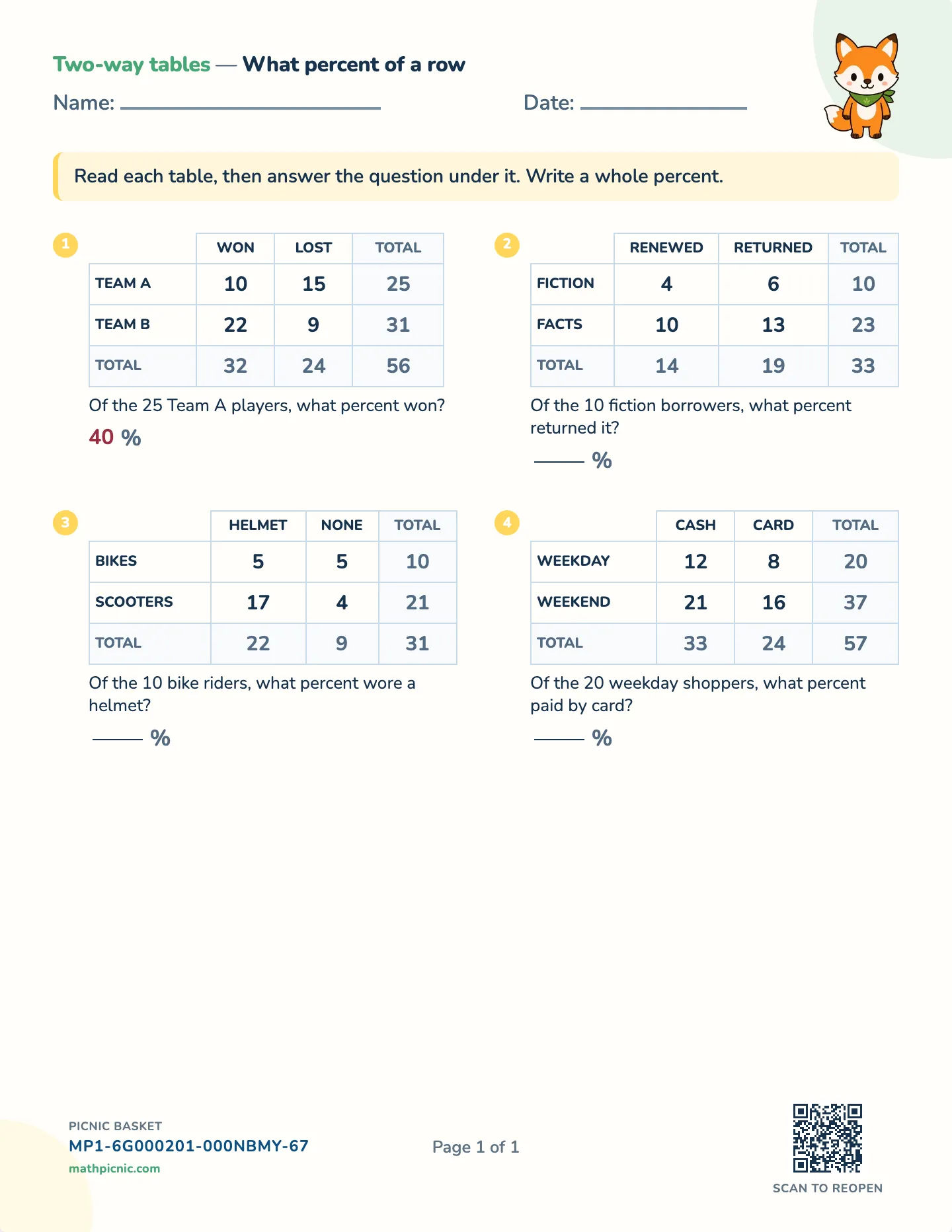
A relative frequency is a count read as a share of a total, written as a percent. These free printable worksheets take it from a two-way table — of the ones in this row, what percent are in that column.
The whole skill is choosing the denominator. “Of the 25 who walk to school, how many bike on weekends” divides by 25 — the row total — not by the grand total of everyone. Divide by the wrong whole and the answer is a true statement about a different question: plausible, unmarked by anything, and the single most common error on the topic.
Why this sheet works
A relative frequency is a division, and most divisions are not tidy, so the row and column totals are drawn from the ones that divide a hundred evenly. Every percent here comes out whole — a sheet asking for 34.7% would be teaching rounding instead — and the answer is the division carried through and multiplied by 100, not the division on its own.
How this one works
One question from a sheet like this one, worked a step at a time — with a sentence saying what just happened and why.
Read each table, then answer the question under it. Write a whole percent.
1
Won
Lost
Total
Team A
10
15
25
Team B
22
9
31
Total
32
24
56
Of the 25 Team A players, what percent won?
%
2
Renewed
Returned
Total
Fiction
4
6
10
Facts
10
13
23
Total
14
19
33
Of the 10 fiction borrowers, what percent returned it?
%
3
Helmet
None
Total
Bikes
5
5
10
Scooters
17
4
21
Total
22
9
31
Of the 10 bike riders, what percent wore a helmet?
%
4
Cash
Card
Total
Weekday
12
8
20
Weekend
21
16
37
Total
33
24
57
Of the 20 weekday shoppers, what percent paid by card?
%
Two-way tables · What percent of a rowAnswer key
1. Of the 25 Team A players, what percent won? 40%2. Of the 10 fiction borrowers, what percent returned it? 60%3. Of the 10 bike riders, what percent wore a helmet? 50%4. Of the 20 weekday shoppers, what percent paid by card? 40%