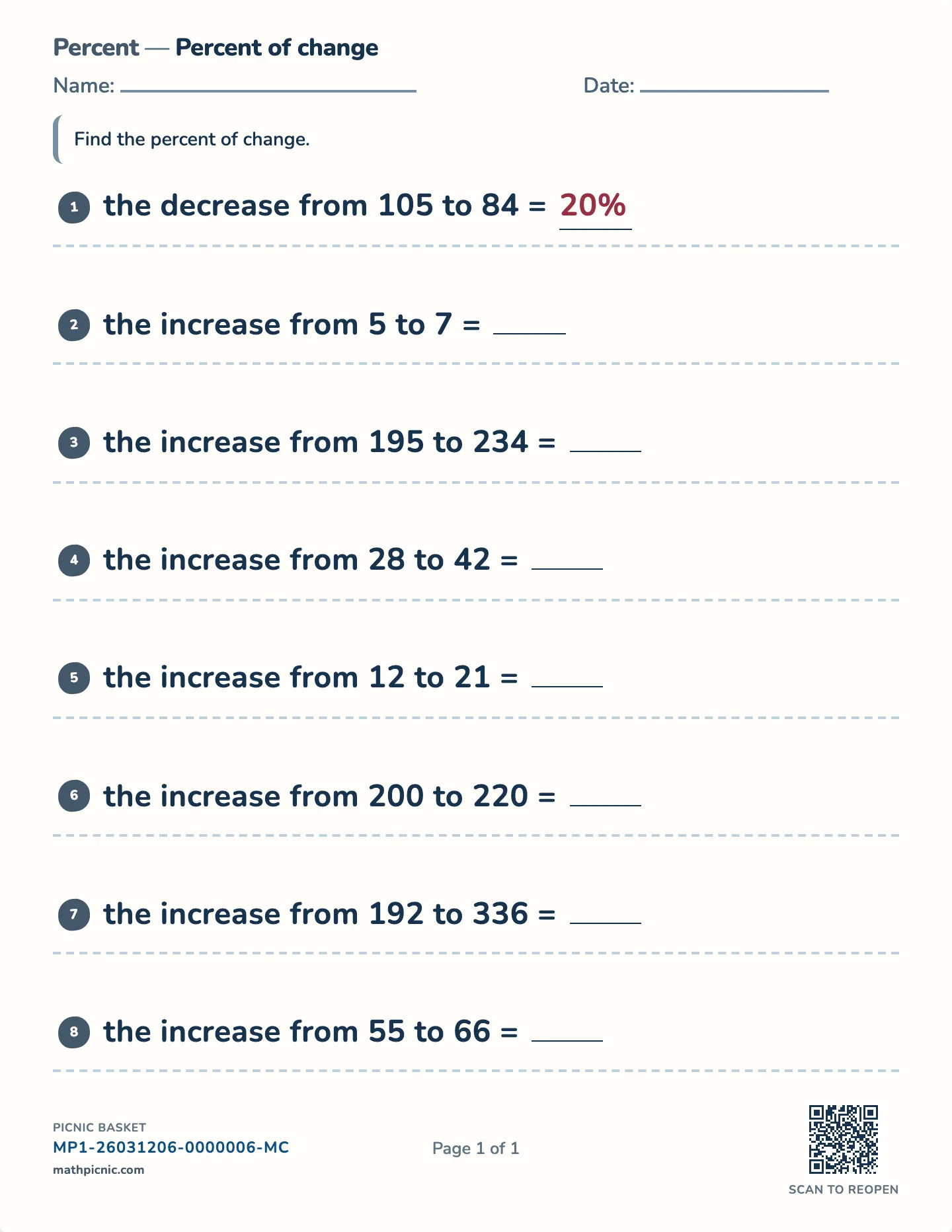
A price goes from $80 to $100 — by what percent did it rise? These free printable worksheets give the before and the after and ask for the percent of change, the reverse of finding a new amount.
The increase-and-decrease sheet gives the percent and asks for the new amount; this one gives both amounts and asks for the percent. It is the reverse move, and it is the one a shopper actually makes — a tag says $80 was $100, and “20% off” is what you work out. Find the difference first, then ask what fraction of the ORIGINAL that difference is.
Why this sheet works
Out of the original, never the new — that is the one thing this skill turns on. From 80 to 100 the change is 20, and 20 out of the starting 80 is 25%, not 20 out of 100. The question always names the direction (“the increase from…”, “the decrease from…”) so the answer is a plain positive percent, and every step-by-step walk divides by the amount you started with.
How this one works
One question from this sheet, worked through a step at a time.
the decrease from 105 to 84
105 − 84=21
21÷105× 100 =20%
First, how much did it change? From 105 to 84 is 105 − 84 = 21.
A percent of change is always out of the ORIGINAL amount, so compare 21 with 105, not with 84: 21 ÷ 105 × 100 = 20. So it is a 20% decrease.
1. the decrease from 105 to 84 = 20%2. the increase from 5 to 7 = 40%3. the increase from 195 to 234 = 20%4. the increase from 28 to 42 = 50%5. the increase from 12 to 21 = 75%6. the increase from 200 to 220 = 10%7. the increase from 192 to 336 = 75%8. the increase from 55 to 66 = 20%