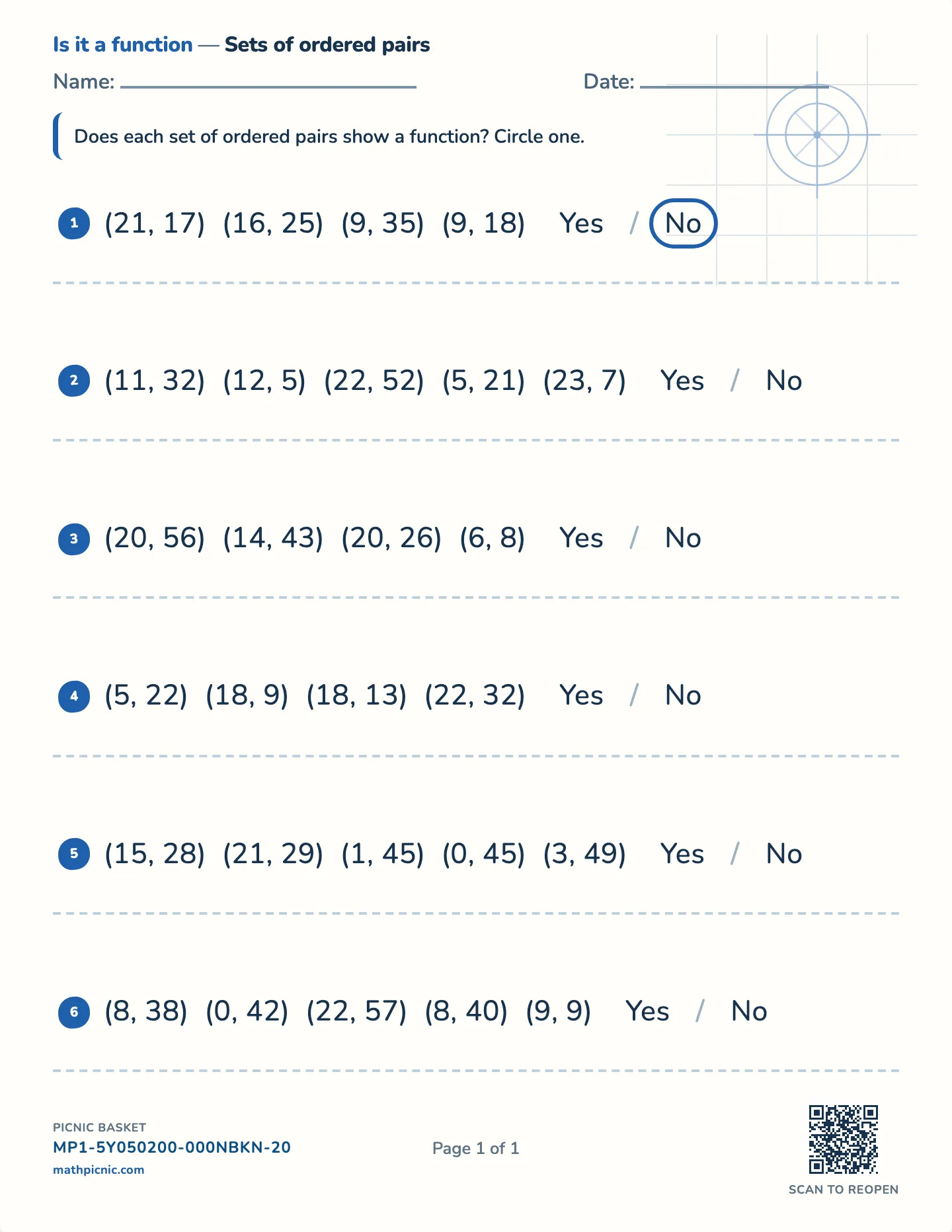
Function from ordered pairs worksheets

A set of ordered pairs is a function when no input turns up twice with different outputs. These free printable worksheets ask that of a list of pairs, where the inputs are scattered among the outputs and have to be found first.

Kid stuck on one? You don’t just get the sheet.

Function from ordered pairs
Function from ordered pairs worksheet — Sets of ordered pairs, free printable with answer key

The answer key prints on a separate page.

What's on this sheet

The pairs are written out of order on purpose. (1, 3) (4, 5) (1, 7) is not a function because the input 1 points to both 3 and 7 — but sorted, that clash sits in plain sight, and a child could answer by hunting for a repeat instead of reading the definition. Left scattered, the first numbers have to be picked out and compared, which is the actual skill.

Why this sheet works

Every sheet mixes in pairs that repeat an OUTPUT and are still functions — (2, 5) (4, 5) is fine, because two inputs may share a result. Roughly half the relations that repeat a number are functions, so duplicate-spotting fails and the rule has to be applied. This is the ordered-pairs half of the function question, kept separate from the table half because in a list the inputs are the harder thing to find.

How this one works

One question from this sheet, worked through a step at a time.

(21, 17) (16, 25) (9, 35) (9, 18)

pairs(21, 17)(16, 25)(9, 35)(9, 18)
pairs(21, 17)(16, 25)(9, 35)(9, 18)inputs211699
Is this a function?No
  1. A function has one rule: every input gets exactly ONE output. So there is only one column to check — the inputs, which are the first number in each pair.
  2. Pull the inputs out on their own and look at them together: 21, 16, 9, 9. Nothing about the outputs matters yet.
  3. 9 is in that list twice, and the two pairs it belongs to do not agree: the input 9 goes to 35 and also to 18, and one input may only go to one place.
  4. One input, two different outputs. That is the one thing a function is not allowed to do, so this relation is not a function.