Is it a functionPairs and tables
Name: Date:
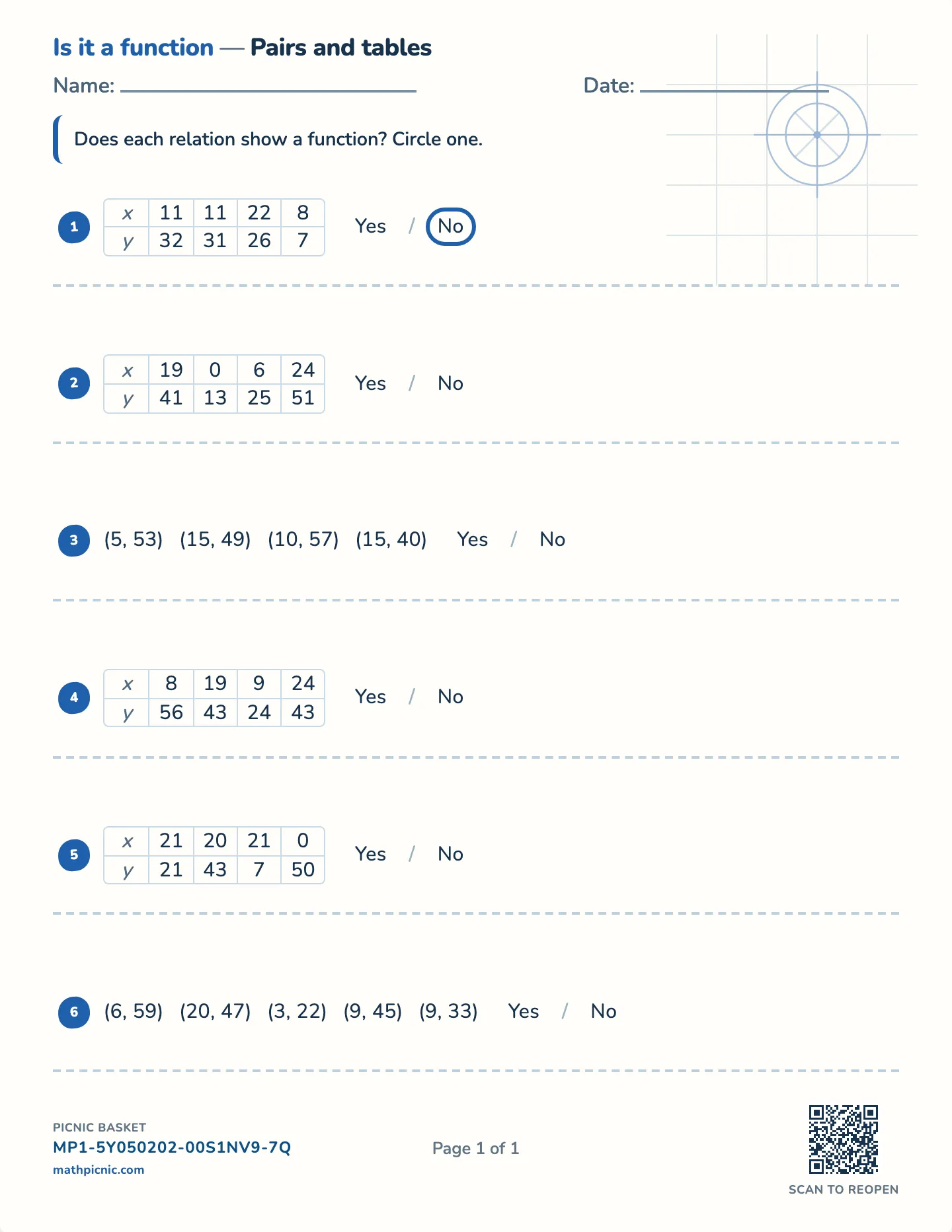
Does each relation show a function? Show how you know.
1x1111228y3231267
2x190624y41132551
3(5, 53)(15, 49)(10, 57)(15, 40)
4x819924y56432443
5x2120210y2143750
6(6, 59)(20, 47)(3, 22)(9, 45)(9, 33)

A function gives every input exactly one output. These free printable worksheets ask whether a set of pairs or a table does that.
If they get stuck
The answer key prints on a separate page.
The rule is one sentence long, which is why it needs a sheet: it is easy to recite and easy to apply backwards. A repeated OUTPUT is fine — (1, 3) (2, 5) (4, 5) is a function, and so is a flat day where every hour reads the same temperature. A repeated INPUT is what breaks it, and only when the two pairs disagree. A child who has heard "no repeats" remembers the ban without the half of the sentence that says which column it applies to.
So every sheet here carries relations that repeat an output and are still functions, sitting beside relations that repeat an input and are not. That is deliberate: a page whose only repeated numbers are the illegal ones can be cleared by hunting for duplicates, which tests eyesight rather than the definition. Roughly half the relations that repeat a number are functions.
One question from a sheet like this one, worked a step at a time — with a sentence saying what just happened and why.
Is it a function?, step by step