ClockTo 1 minute
Name: Date:

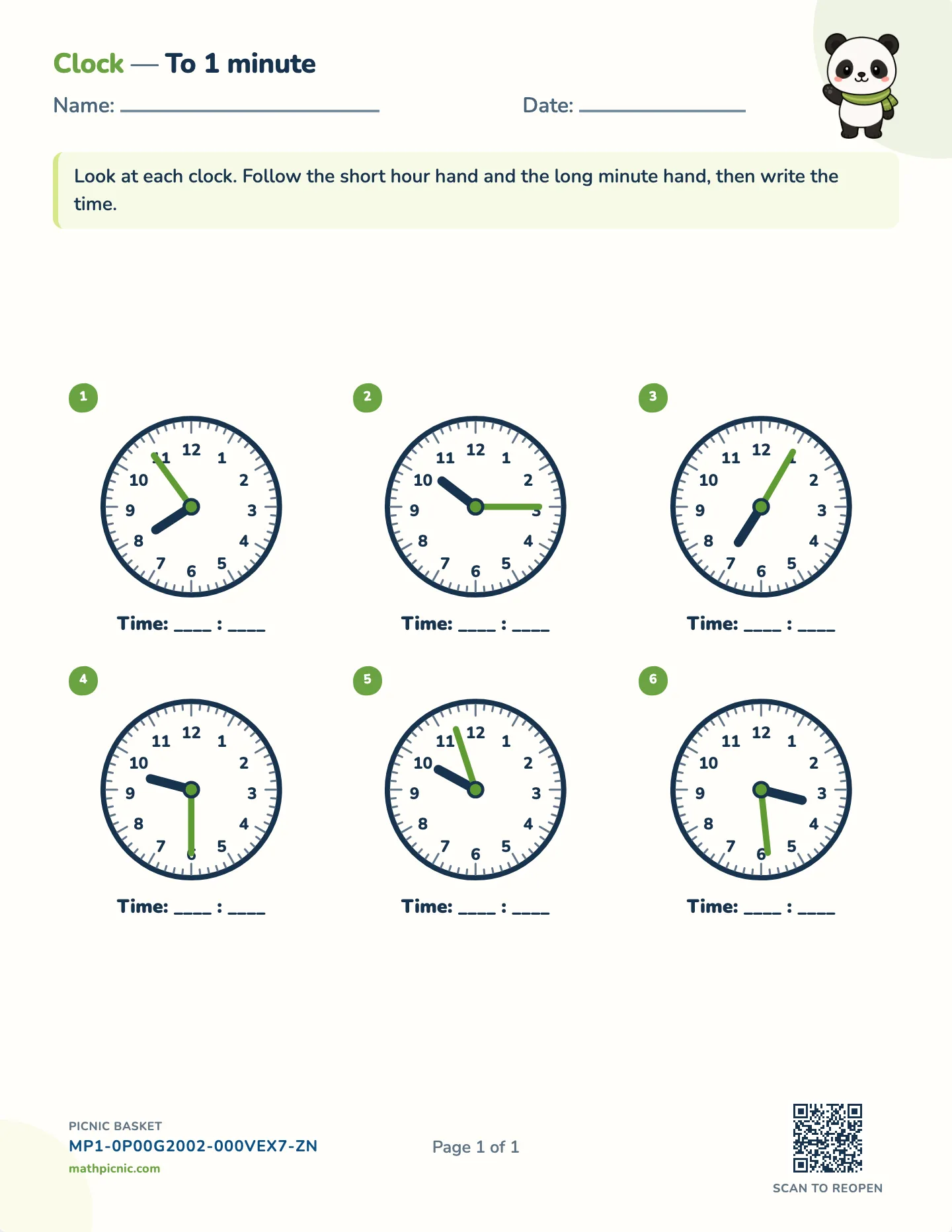
Look at each clock. Follow the short hour hand and the long minute hand, then write the time.
1
2
3
4
5
6

The last step in reading a clock is every minute, not just the fives — where the minute hand sits between two marks and the child counts on from the nearest five. These free printable sheets ask for six clocks read to the exact minute.
If they get stuck
The answer key prints on a separate page.
To the minute, the fives become landmarks rather than answers. The child counts round the face by fives to the mark before the hand, then counts on the extra ones — 5, 10, and so on to 35, then 36, 37. It is the reading a real clock actually needs, and it is where careful counting replaces pattern recognition.
Each of the six clocks sits at a different minute and a different hour, so the answers share no shortcut. The hour hand matters more at this precision, sitting most of the way to the next number as the minutes climb toward sixty, and the child learns to read the number it has passed rather than the one it is near.
One question from a sheet like this one, worked a step at a time — with a sentence saying what just happened and why.
Tell time to the minute, step by step