Given two points, the slope is how far up over how far along. These free printable worksheets give the coordinate pairs and ask for the slope, with whole-number answers throughout.
Rise over run is the whole formula, and writing it in words beats writing it in subscripts. From (2, 3) to (5, 9) the line goes six up and three along, so the slope is 2 — and a child who says it that way never has to remember which coordinate goes on top.
Why this sheet works
Subtracting in the same order on both the top and the bottom is where it goes wrong. Take the y values in one order and the x values in the other and the sign flips, which turns an uphill line into a downhill one. Sketching the two points before calculating catches every one of those.
How this one works
One question from this sheet, worked through a step at a time.
(−4, 8) and (0, −4)
(−4, 8)and(0, −4)
up=−4 − 8 = −12
across=0 − (−4) = 4
−12 ÷ 4=−3
m=−3
Slope is how far the line climbs for each step across. So take both differences between the two points — and take them in the SAME order, second minus first, both times.
Going up: −4 − 8 = −12. Going across: 0 − (−4) = 4. Swapping the order on only one of those is what turns the sign the wrong way.
−12 up for every 4 across is −12 ÷ 4 = −3 — the line falls 3 for each single step across. So m = −3.
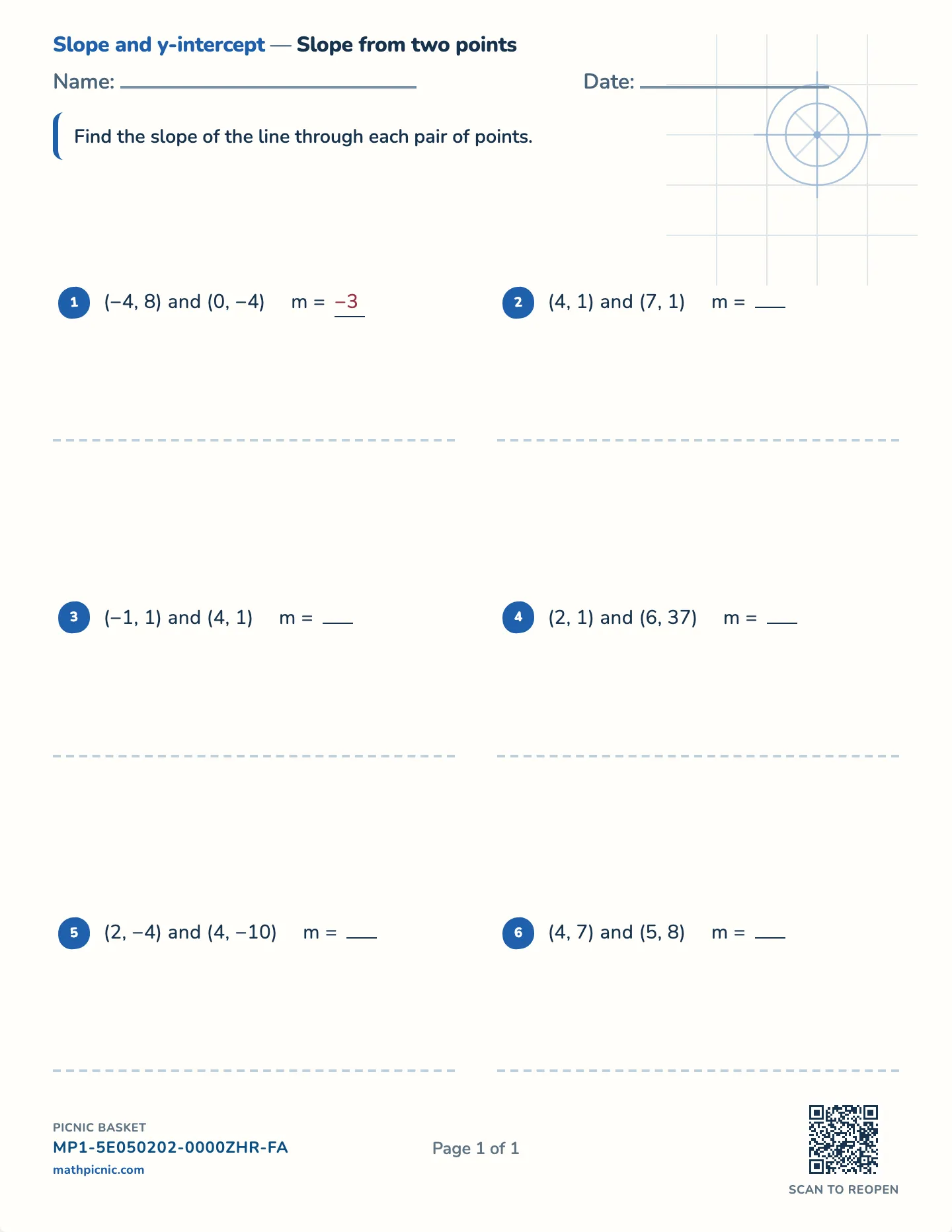
Find the slope of the line through each pair of points.
1(−4, 8) and (0, −4)m =
2(4, 1) and (7, 1)m =
3(−1, 1) and (4, 1)m =
4(2, 1) and (6, 37)m =
5(2, −4) and (4, −10)m =
6(4, 7) and (5, 8)m =
Slope and y-intercept · Slope from two pointsAnswer key
1. (−4, 8) and (0, −4) → m = −32. (4, 1) and (7, 1) → m = 03. (−1, 1) and (4, 1) → m = 04. (2, 1) and (6, 37) → m = 95. (2, −4) and (4, −10) → m = −36. (4, 7) and (5, 8) → m = 1