
Daily math practice for 1st grade
Five sheets, one a day, taking addition from the facts a child already owns up to the crossing-ten step that first grade is really about.
What the 5 days look like
Addition within 20 · 5 daily sheets plus an answer key and a story map — 7 sides in all.
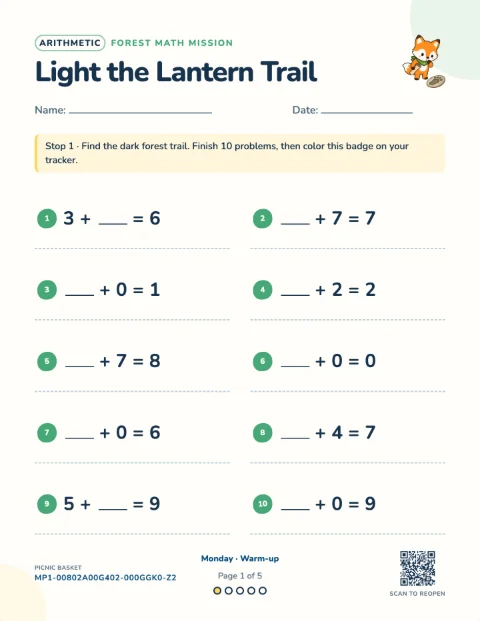
Monday Warm-up
Monday stays under five — 1 + 1, 2 + 1, 1 + 3.Tuesday Build
Tuesday works up through the teens with one small addend.Wednesday Practice
Wednesday mixes the sizes so the sign has to be read.Thursday Stretch
Thursday runs to the top of the range with easy pairs: 18 + 1, 0 + 19.Friday Challenge
Friday is the crossing-ten work — 8 + 12, 5 + 15, 9 + 8.
Why a week beats one long page
First grade's demand is fluency within twenty, and fluency is a function of frequency. Ten minutes on five days does more for recall than an hour on one, because what is being built is retrieval rather than understanding — the child already knows what addition is by now.
How to run it
The hard part sits in the middle of the range, and the week is arranged to arrive at it. Monday's sums stay small enough to be counted; Friday's include the pairs that cross ten, where counting on fingers runs out and a make-ten strategy has to take over. A child who meets those on Monday just counts; a child who meets them on Friday has had four days of groundwork.
Same week, different skill
Other Grade 1 packs
Every one of these builds a pack that gets harder day by day. A single times table fills three days rather than five, because ten facts can only come back so often. Skills whose questions are all one weight are left out.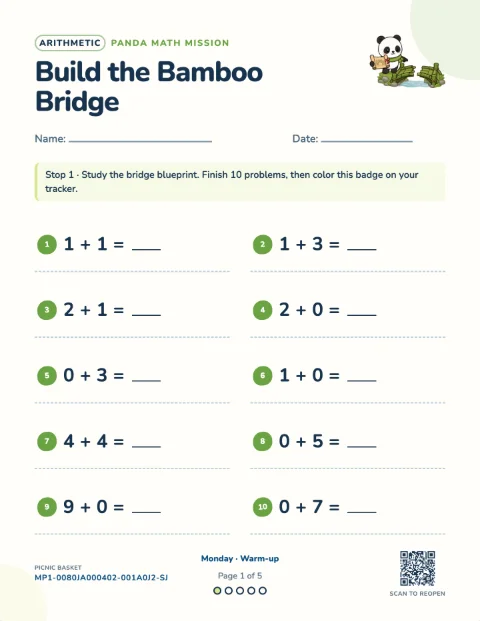 Customize Addition within 20 5 days MP1-0080JA00102-001A0J2-8C
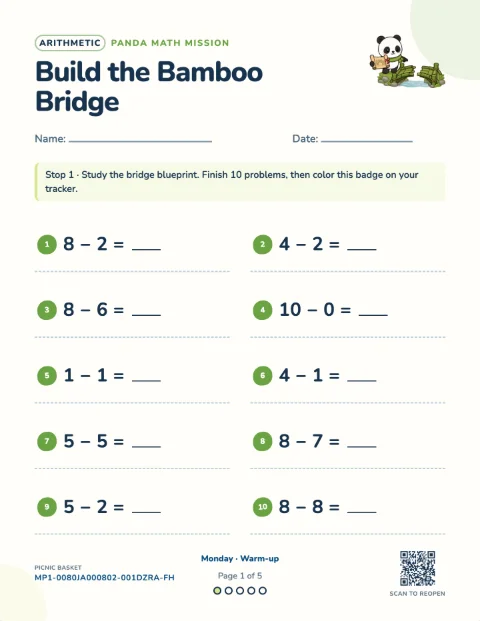 Customize Subtraction within 20 5 days MP1-0080JA00202-001DZRA-DX
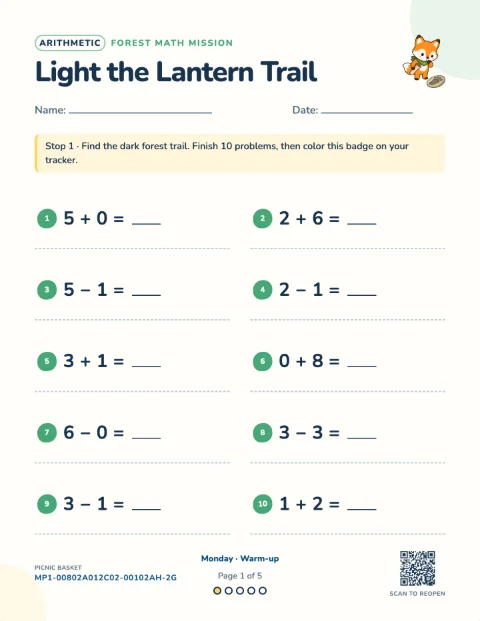 Customize Mixed addition and subtraction 5 days MP1-00802A08K02-00102AH-VP
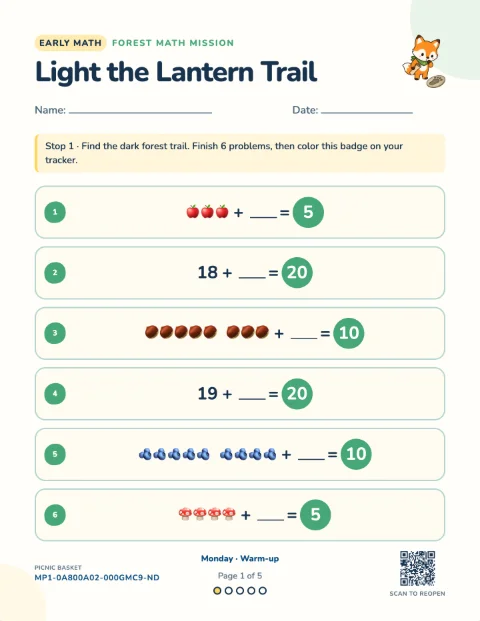 Customize Number bonds 5 days MP1-0A800A004-000GMC9-ZZ
 Customize Missing addends 5 days MP1-00802A04102-000GGK0-NH